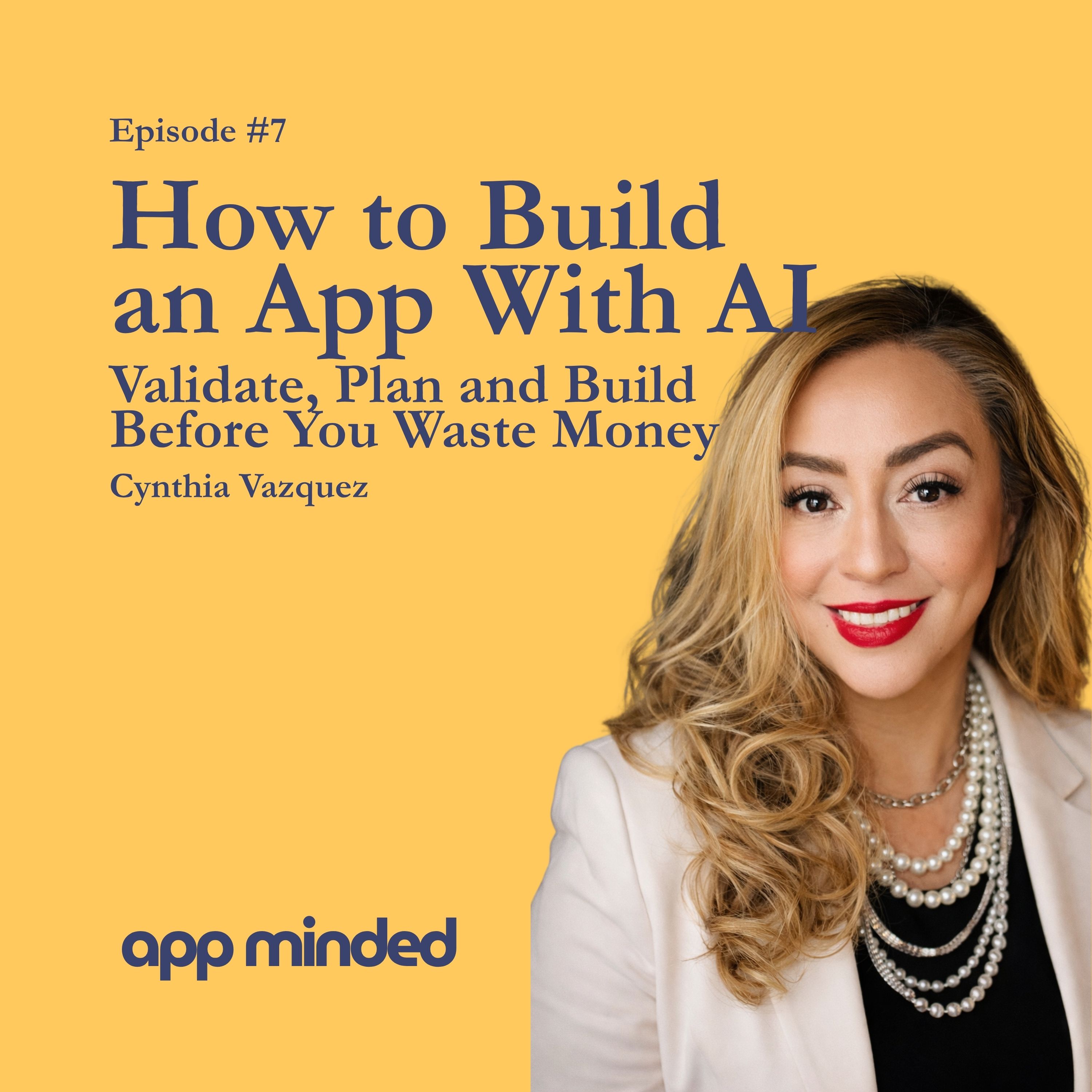
Building Apps with AI: What I Learned Along the Way
Show notes
AI is becoming part of how we work, but many professionals are still figuring out how to use it without feeling overshadowed by it. In this episode, Cynthia Vazuqez, AI strategy consultant and founder of Lead with Impact, shares her philosophy of amplification over automation and how she uses AI to enhance skills, solve problems, and build impactful apps.
The Importance of Amplification, Not Automation
Cynthia Vazuqez describes herself as a lifelong learner who has trained over 1,800 professionals on integrating AI into their workflows. Her approach is simple: AI should accelerate human potential rather than replace it.
Why Choose Amplification?
- Enhancing Efficiency: AI tools can streamline work. When Cynthia first used AI for proofreading communications in high-stakes environments, she found it saved time while improving the quality of her work.
- Learning and Growth: AI can act as a thought partner, challenging you to think critically and creatively. Asking the right questions can uncover insights and fill gaps in your knowledge.
Building Your First App with AI
Cynthia’s journey into app development began with a desire to create tools that bring clarity and support people in their daily lives. One of her first projects was an app designed to help users focus on their weekly goals while accounting for personal factors that affect productivity.
Key Features of the Clarity App
- Personalized Goal Setting: The app considers users' mental and emotional states alongside their commitments, then suggests what to prioritize.
- Holistic Approach: By considering personal circumstances, the app helps users balance their goals with their well-being and recognize when rest may be needed.
The Iterative Learning Process
Cynthia emphasizes that building apps isn’t just about launching. It’s about learning and iterating. Platforms and tools constantly evolve, requiring builders to adapt their designs and functionality.
Lessons from Iteration
- Understanding Tool Limitations: Builders need to understand the tools they use. Cynthia learned firsthand how platform credit systems can create unexpected costs when they aren’t managed carefully.
- Embracing Change: The tech landscape moves quickly. Keeping up with new features and capabilities can improve both the quality and efficiency of your builds.
Finding Problems to Solve
A crucial part of app development is identifying real problems worth solving. Cynthia encourages aspiring builders to look at their own experiences for potential app ideas.
Strategies for Identifying Problems
- Personal Experience: Many useful apps start with a problem the founder has experienced or witnessed. Cynthia’s app for federal employees navigating career transitions grew from seeing colleagues struggle during layoffs.
- Market Research: Before building, look at what already exists. Understanding competing solutions helps refine your idea and identify where you can offer something better.
Full transcript
Auto-generated transcript of “Building Apps with AI: What I Learned Along the Way”. Lightly unedited.
Nina Kolari: Do all your planning and iterating outside of wherever you're building so that when you go to build, it is as straightforward as possible. Welcome to AppMinded. My name is Nina Kollari. I am an AI product builder and have shipped over 20 web and mobile apps in the last year. I'm in a mission to help you create your very own apps with the help of AI, with or without technical background. Today, my guest is Cynthia Vasquez. She is the founder of Lead with Impact and a strategy consultant who have actually taught almost 2,000 people on how to use AI. Initially, she was a little skeptical about AI when her kids showed her AI and she was not impressed. But her mind was changed at work when she had to submit something to the Congress and had only 20 minutes to do so. So she gave it to AI and rest is history. From there she started building apps to solve her own problems. One example, a goal setting app that really takes the whole life into context, not just to-do list. And to top it off, she created AI assessment tool or an app that actually wanted hackathon. So let's get into it. Welcome Cynthia. I would like you to start off by telling the audience who you are and what you do at the moment. I'm a lifelong learner. Cynthia Vasquez, I'm the founder of Lead with Impact, AI strategy consultant. I've trained over eighteen hundred professionals globally on how to integrate AI without losing what makes them irreplaceable. My philosophy is simple amplification, not automation. Your judgment is the filter, AI is the accelerator. Let's get after it. That's awesome. I really like that it's not replacing anything, it's just It's a another layer on top of all the life experience ⁓ people have. So how did you even get into AI? I I love that question. Thank you, Nina, for asking it. I was a skeptic. I tried it. My kids, I remember picking them up from school and they were excited to share that ⁓ that they had seen their classmate do it. And they were super enthusiastic. I tried it when I got home and I was not a fan. And I put it down and never tried it. for a long time until I was forced to try it because I needed to help proofread a lot of the communication pieces I was putting together. So I was in a role in my agency that oversaw communications to internal internal and external whole stakeholders to include Congress. So there was very high stakes, short turnaround times, a lot of pressure. Sometimes we w had to put a very a memo policy and we had twenty minutes to do it. Right. And not having anyone to look through it was very stressful because sometimes my and usually the draft that I submitted was gonna be the final copy, no edits. So I needed to make sure it was beyond perfect. So being in that I had to try it again and little by little, the more I used it, I fell in love with its capabilities. Because like I mentioned in my introduction, right, it wasn't not only it wasn't replacing me, it was augmenting me. It was making me more efficient and at the same time more proficient. And why I say that is because a lot of people think, you know, it's gonna replace you or take away your brain power. And how I use it has actually made me learn more because I'm asking it questions that and and I'm asking it to fill in the gaps in my thinking. help me ensure that I'm not missing any critical steps and in doing that doing it using AI in that way is become a thought partner that not only helps me but challenges my thinking and because of the back and forth helps me augment what's already within. Yeah, yeah. I really like that that it's like a thought or thinking partner. Because I think If you use it correctly and like you said, the more you use, the more you realize the benefit of it when you start actually learning to use. Since my podcast is about apps, I know you've actually built quite a few apps. So can you maybe walk me through the first app that you built with AI? not sure even remember which one was the first one because there's been so many. One of the first ones that I did so I had done a lot of similar like smaller scale things, right? Like ⁓ surveys where I did a little web app, which I don't really consider necessarily a whole build because it's very easy and low effort. Not a lot of thought from a security standpoint, cybersecurity standpoint. data protection, you know, you and not a lot that goes into that kind of build, right? Because it's just clicking. And I've done a lot of websites and stuff like that. But my first more robust actual build was a app that helps you get clarity. And what I mean by that is it helps you focus on what you have that week based on where you're at. Not only goals wise, but also mentally, emotionally And it it takes into account what you have going on that week. So it's a really cool app to get clarity on what to focus on. And kind of it's a goal setting app, but it takes into account all these extra factors that help you get to your goals in a way that's taking all of you into account. It takes into account your other commitments, your short and long-term goals, and like I mentioned, your health, your family life, and what else is going on. And then it assesses where you're at, gives you kind of a map about what your week looks like and where your sh you share your energy should be. So for example, like let's say this week I go into it and I tell it, you know, my allergies are horrible, my kids are going back to school, and it's my niece's wedding this weekend, right? It's gonna tell me, even though I wanna, let's say, be a guest on five podcasts, and that's my goal for this week or for the month, right? It's gonna tell me you have too much rest. Take care of yourself, right? So it does a really good job about kind of helping you think short and long term and get that clarity that sometimes while we're in the hustle and bustle is hard to get. Yeah. Yeah. ⁓ absolutely. It is it is so easy just to go into this kind of tunnel and just keep going when you really should be resting and taking time off. Exactly. What what tool did you use to build that first app? I use Claude for sure. And I think I built it first on Lovable, then I did the same build in Replit, and then I ended up just self-hosting it through Versailles. Okay, cool. So you've dabbled into many tools. Were the tools familiar to you when you started or did you just learn as you went and built? So it's been a learning a a learning journey and because I continue to play with all the tools. So all these tools I had never used before. And you know, I've I I love learning. I have two master's degrees, but I still take college courses here and there just because I believe that's what life is about, right? It's about being a lifelong learner. And I as a as someone who's been in many leadership roles, I've always thought that for the team to do and get better, the leader needs to get better, right? As the leader gets better, the team gets better. So I've always taken upskilling very seriously. And why I say that is because even now, if I hear of a new tool, I'll come up with a diff a unique build or something to play it out and try it. So for example, Google Albni was just released yesterday. And even though I had had a really long day, I still played around with it. And to see what the capabilities were like, right? And again, right, because as I do this work, these type of workshops, interviews, podcasts, it's important that I know and can adequately and truthfully respond to some of these questions. Long way to say, all these tools were new to me and I I keep learning as I go. I love them all. I think each tool has its own merit. So for example, depending on what I'm gonna do, even though I could do a bigger build and more robust build outside lovable or reply. Sometimes I just use those because it's so much faster. Right. Depending on how much time and what ⁓ and kind of like my app, right? Depending on the time and the energy that I have will determine which one of these platforms I will use. And usually though, most of my building does involve cloth at at a minimum just for the planning level. Yeah. Yeah. Yeah, I I agree. I think lovable is phenomenal for non-technical people who don't want to deal too much of the tech issues that eventually you will get into. So in the ⁓ discovery ⁓ form, ⁓ you mentioned that one of the things that a builder needs to find is a problem. Like genuine problem and find the audience. And that is actually one I think one of the hardest parts for many builders. Because AI can now do the coding, but still the product needs to be created by the person and the human and come come with the experience. So I'm very curious to see how do you come up with the app ideas and the problems you actually want to solve? Where do they come from? Great question, Mina. So for me, it's come as I just encounter my day-to-day. And what that means is that I have too many builds, too many things I want to do. Because as I encounter something, I'm like, wait a minute, that could be an app, right? Yeah. Or it could be something else, right? That I can use the eye for. And and I think I see that often, right? That people are building apps for things that can be a prompt. And that's my biggest advice for people for before you get to building first consult an LLM or even just Google and ask, is there an app that does this? What does it look like? Because sometimes you are just gonna be doing all this work that's gonna go nowhere because it already exists and maybe 20 other versions just like it, right? So and if you're really passionate about it, I would recommend that you know you see what you can bring to augment what's already there. Right. And usually it's coming from our identity. So I I really want to emphasize though that how you go about this, there's no right or wrong way. A lot of people propose a lot of things. I've actually no met several people who've developed apps to help you identify a problem statement. People reverse engineer it. To me, what makes sense is based on your shared experience, right? You are your expert on your circumstances. So for example, One of the apps that I've been working on and very passionate and excited about and it's fully built and it's been built for a while now, but I just haven't had the time to test it through and make sure, you know, that there aren't any bugs and I haven't got any beta testers, but it's a transition app for federal employees. So what it does is yeah, it coaches them, you ingest your resume, I helps you identify how that translates to private industry, rewrites your resume for you. Helps you do the interview prep and also helps to identify areas which you can go into that you hadn't thought about. And then also creates like a career map for you, like where up what upskilling you need, and so forth, right? And how I came up with that is just seeing so many of my colleagues and peers being displaced by a lot of the cuts in the federal sector, right? So, and that's where it goes back to your question, right? About how do you find that. problem statement, what are you solving for? I really believe it should come from where you're at and what your lived experience is, right? Because who better than that is than you that knows a problem as intimately as you do, right? And and that's what that's how I came up with that app, right? Because a lot of my colleagues are going through this and needed the help. And as I've had these conversations, I was like, ⁓ if only we had this or if only there was that, right? And I was like, well, wait a minute, I started compiling it and little by little started building that out. Yeah. Yeah. I think ⁓ it's best to fix your own problems first or anybody near you so you can really get that. Market research is a hard thing to do if you need to do it from completely new problem. It is a task and job on its own. But when you fix your own problems, you're the best case study and These days you can sell globally so you always find enough people that have the same problem that you've had. I think it's ⁓ many actually so far all of my guests have fixed their own problems. And that's what makes them all the solutions are unique and they're different from all the other things in the market, which I think is pretty important. Those were a couple of apps. Any more apps that you'd like to talk about that something that was different or the build process was maybe challenging or do you have an example of that? I think with each build there's something new or different, right? And ⁓ and part of it is because the platforms are continuously changing and improving, right? So I've had versions where I've built it several times because when I launched whatever app that was, the capability wasn't there to do X, Y, and Z, right? Especially with platforms like Replit that they keep enhancing. And adding so much functionality, for example, like videos and stuff like that. So what I what's to me is exciting is that they keep getting better. But also what it means for someone that's building is continuous iteration and just coming to terms that that's that's just the world we live in. And it's a good thing, right? It's just finding the time To go back there and update it to make sure you have the best and greatest. One of the things that I've encountered in a lot of the builds is the importance of being aware of two things. How context memory with whatever tool you're building, how it factors in. And tied with that is token and credits. No matter where and what you're building, it's critical that you do the research before you start building. And clicking away because unfortunately a lot of people end up spending way too much because they didn't do the work beforehand. And I've learned this the hard way, right? So for example, I've because I had done several things with Lovable, I felt really confident. And even though I had a good plan, when I went to build, I quickly exhausted my credits, right? Because I was having too many back and forths. And I was thinking it was doing tokens versus credits. And I just forgot that lovable is different. And I've been fortunate to not have that issue too many times. It's happened to me also on Repli. I think it's common, right? Because you get in the build and as you're doing it and you see what it looks like, you're like, ⁓ no, maybe let's reconsider the font, let's reconsider the color. And then you start getting picky and before you know it, you're in the hole. Right? So one thing I would recommend is especially with Claude and now its ability to do a visual kind of an illustration of it, I would say do that and do all your planning and iterating outside of wherever you're building so that when you go to build it as straightforward as possible. Right. Because even though I go into these builds, if I'm using something like Replet or Lovable, I'll come in with my MD file ready to just execute. There's still issues that need to be clarified or ways to improve it. So you're not gonna get past that using a lot of tokens, right? Or credits. But the more prepared you are at the onset I highly encourage you to do that, right? And I again I learned this the hard way. So initially I'd have an idea and I'd start building it right away. Now, and I think to answer your question, that's the issue that I've dealt with, right? In building these things. Now my approach is different. If I have an app idea or a build idea, I will first do the market research, see what's out there, see if the it's even worth monetizing and pursuing that work. And some I don't care about monetizing, I just want to help people. So I'm okay with that, right? ⁓ but I again I don't want to reinvent the wheel if it already exists. So first I start off with validating my idea for the app. Then after that, I create a project in Cloud just for that app. And then I start thinking about what I want the user to experience. What things would be helpful to them. And and then I I really take my time to think it through not only what the goal of the app is, but how you get there, right? Because it's easy to have a goal and say, ⁓ I really want an app that helps me find the the nicest, I don't know, lipstick, right? And but what are you gonna do to get there, right? Do you want to do website? Do you want to do in-store? Do you want it to be in your local community? Do you want it to be walkable? Do you want to be drivable? So you have to sit with the pro problem long enough. Or at least a while. And I like to also get people's opinion. So I love asking my kids. I'll be like, hey, listen, I'm thinking about building this app. What do you think? And oftentimes they are brutally honest and will give me really brutal feedback, but helpful because then I can take that into consideration and refine or improve the build based on it, right? ⁓ and it gives you time to think. So for example, one of the apps that I'm developing. Actually, it's already done. It's a communications app and it's to help you coach to become a better speaker, do your elevator pitch, do interview, ⁓ prepare interview pre preparation. Also, it ⁓ records you as a teleprompter and gives you a rating on your speed, your mannerisms, how you're showing up, all these different things. It's really really exciting. I'm very proud of that build. And with that, it I took me about Six months I want to say in the planning phase. Why? Because I wanted to make sure I did research, what was out there, research how people can improve their communication with things to measure, right? And even though I wanted it to be I knew from the onset I wanted it to be something that helps people initially it started with just pitching, right? How to be better at your elevator pitch and then if you're pitching your business, how to do that. But then I thought, well, if I'm already doing this, why not build out all these extra features, right? And it grew from there, but it wouldn't have happened if I had just rushed into the build. Right. It may have come down the road, but I think the build is stronger from the onset because I have all these layers already built in that if I would have to reverse engineer it, if I had just done it for the elevator pitch and business pitch, and then add all these other extra functions, it would have almost had to be a new build from scratch. Right. So it I would recommend taking the time to plan it out, see what other features you can add, and invite your LLM of choice to be a thought partner and ask it. Here's what I'm thinking, what's good, what's not, it would it be of value, who would be the target audience, how could I refine it? How can I augment it? What liability issues are there? Right. I know me and my kids were thinking of building an app. And it told us do not do it because people are gonna come after you harsh. And I'll tell you what that build was. It was basically you put in the link and it tells you in sites why it's true or not true. Kind of like a fact checker, but it would also go a step further and tell you why it's not and blah blah blah. And basically all the LLMs we consulted said, Don't even bother because it's a lawsuit waiting to happen. Yeah, yeah. It's a actually very interesting to listen to you. I'm very curious about your background because you talk about the building process and what happens before and the code. Like in your day job or in the past, have you been building products before? Or was this are these products just something building a product, is that that a new skill that you just acquired in the last few years? Thank you, Dina. So I'm kind of in the middle. And why I say that is because early when I was going through college, I actually learned DOS and I learned HTML. And I did do so I was in education, so I did do like several curriculum designs and units that were all online using HTML. So I had done that at that point, but then hadn't revisited it for years until more recently. And ⁓ I'm curious to know what I what prompted you to ask that question. You speak it sounds like you have long experience building products. Like the whole process. I understand because you build a lot of products, you also learn. But I was like, if this is what you started with, like completely from zero building products and you talk about customer journeys and all the rest of it, it sounds like you have more experience than just starting like couple of years ago. That's what it feels like. So if it's just been last couple of years, it's a phenomenal story and how by literally doing another product and another product you actually developed that skill to the expertise. Thank you so much. I appreciate that. I I'm glad I asked the question. But you know, I think it's it has to do a lot with the roles I've had. And what I mean by that is you know, the educator in me always had to put together a lot of curriculum, right? So a lot of thought goes into that. So I think that's helped me now in this realm. And then as a leader, I've also had a do a lot of conference designs and planning, right? And then I did do a lot of PMP courses in camps. So I think that's also helped. And then also that role that I mentioned in with my agency where I was part of the comms unit. And as part of that, it helped me really develop a mindset of internal and external and how it's perceived by others. So I take that into everything that I do, fortunately or unfortunately. And the other thing that I think has helped a lot with this mindset is that I do a lot of work with founders. So I'm part of ⁓ st different startup groups in San Diego. So that helps me kind of think about things from a business standpoint in addition to just building. And and that's where I think these these conversations and spaces like these matter because I would encourage anyone who's be looking to build to not focus on just the tech skills, but focus on other things that can enhance your build. Because you bring more to it and your b the build will be better by it, right? At the end of the day, you know, our lived experience and how I mentioned at the intro, that is our unique value proposition. And it shines through in everything that we do, whether we like it or not. And from a building standpoint, I think it can help be that differentiator that propels you forward and your build. It makes it more happy. Yeah, absolutely. Absolutely. And I loved hearing when you were explaining your background. There's a lot of diverse things, but none of them were l really about building a product or building with AI. But you you were able to utilize all of the various experiences you've had in your life now in a completely new way. And I think that's the beauty with AI and how AI can enable us utilize all the various skills and mash them into together and create solutions for others. And I do have to mention, with all those skills, you've also joined a hackathon. Can you talk me too about the hackathon experience? Well it was funny because it just came up and we had like a week or two advanced notice and I thought, well should I do it, should I not? And I thought, well, what have I got to lose? And actually I had about eight different ideas and I wasn't sure what to go with. And I decided to go with an AI readiness assessment. And there are and there was some hesitation there because there's a lot of already tools that do that. But what I did was different. I brought in my experience and my take to it. Right. So what's already on there is very objective. And focuses on the traditional enterprise only. I took into it the PMP mindset per se to the build. I took into it psychological safety. I took into it a lot of other stuff from other disciplines and made it a very robust tool. Nothing like that is on the market. And I'm happy to share that I won. And it what it is is basically it has three different tiers, A, B, and C. A is one if you are short on time, that you answer a few questions and it'll give you an overview of where you're at for your enterprise to adopt AI. It asks a lot of thorough questions, and that's a full build. It'll it's about 250 questions, takes about 45 minutes to to answer, but it asks if your data is ready, how is it stored, who has access to your cloud, what it I mean it takes into account all these different fields to include cybersecurity. protecting of data and also upskilling and what your workforce looks like and the environment. Is it ready for an implementation of this magnitude, right? And what does it look like? Will have you talked to your external partners to see if there's gonna be any issues with the data and ⁓ the tools? Will they talk to each other or will it actually create more problems? All these different things that are important as enterprises take on an AI implementation initiative. Yeah, and congratulations on winning. It's no ⁓ small feat ⁓ winning a hackathon. You build quite a lot of apps. What's coming next? What do you think you'll be doing next? Do you have new app app ideas or are you refining the old ones or a little bit of everything? So because I have so many ideas. There's so many builds I have in the pipeline. But right now my focus is I was accepted to be a cloud partner. So myself and my cohort are almost ready to take the test. So that's my primary focus to become a cloud certified architect and get that certification not only for me but for all my colleagues. So that's the first step. Then w once I accomplish that, my goal is to do better about promoting my apps and what I mean by that is because I've created a lot of stuff but haven't had the bandwidth to promote them and get testers ⁓ on them and that's what what next looks like. At the same time I know I will inevitably build some more stuff. Right? It just kinda kinda happens. So just this week I built a new one for this upcoming workshop. We were gonna just do a live iteration but then it made me think well wouldn't it be cooler if I just build the app And they play around with it and I can talk to them about how I did the build, how it came to be, and how long it took me. Because it was impressive. It took me like five, ten minutes to build it. Yeah. Right. And and that is just mind blowing because it's really nice. It has my branding on there. It got the colors right. But again, just because I had done the legwork of having a plan in place, the execution was so fast and successful overall. So That's my plan. ⁓ clean not clean up but continue to test the apps that I've already have and launched, promote them more, and at the same time be more mindful of the apps I build because there's no point in building something that's gonna go nowhere, right? And have and having that intentionality I think will help for token preservation and also bandwidth, right? Just because you Build you you have an idea doesn't mean you need to build it right then and there, right? And I I think I also need to work on that. Give myself more grace and not want to build it all in one weekend. Yes, yeah. Do you have any plan in place how you think you'll be doing the marketing? Are you gonna do like building public, kind of sharing your story as a builder, or are you doing advertising or like organic social media? Do you have any plan? So Unfortunately, because my time is so limited, my plan is to just use Sabrina Rabinoff's Lotato to do automated content across multiple platform platforms. And then I was waiting on Google Omni's to release to do some videos. And I'm hoping faceless videos. And now that that's out there, I mean it does a nine-second clip really fast. So I could see it. I could see myself sitting down an hour into generating at least four videos that I could drop one a week on just my apps. Yeah. That's really good. They say that the building has become so easy that the hard part now is the marketing. Yes. And I agree, right? Because ⁓ doing a video and you know this first hand, right? Takes so long. The editing, the the audio, fixing the issues, it just it's It's very time consuming. And I don't want to have to do that in the sense that I don't wouldn't mind it. I just don't have the luxury of time. So I was waiting for Google Obdi or a tool like it to make it very easy and cost efficient because I have played around with other tools like Vio or Cling or Hicksfield, but the cost is just too much. to do it on a regular basis for something that is not generating profit yet. Right? Maybe at a later time I'd consider something more robust. But now with Google I feel like I can really leverage that tool to get more content out there to help promote my apps without impacting what my day to day looks like. Yeah. Yeah. It is it the marketing is a it's another full time job if you really wanna, you know, do a whole lot of lot of it. But luckily the AI can automate quite a bit of it. These days. It really does help to learn tools not just for building but also marketing quite a bit. So what what would you say to somebody who's listening here? Like they have an app idea. Something in there like, ⁓ maybe I should. Could I? Should I? What would you say as an advice to somebody who's never built anything but has an idea? The first step would be for me to write it down. Right? Because maybe It's a great idea and you don't know if you'll remember it, right? So I would say write it down and then start doing the research. Start by asking Google or any AI L L ⁓ is there something like this on the market? How are they monetizing it? And who's the target audience? What are the key key elements of that? Right. And then seeing, you know, does is that what you were thinking? Does it resonate? Do you want to put put ⁓ continue moving forward? And I would encourage people to even ask the LLM back, right? Let's say they say, ⁓ that app is a great idea or it's not because XYZ. And I would encourage to push back and say, why not? I'm I'm doing the same, but I want to do this. W wh give me your thoughts on that angle, right? And and kind of just thinking it through. And the What I would say is also especially the monetization monetization aspect. That's critical. I've had a lot of people approach me and have asked, Can you build this? or I have this app that's gonna make me rich. Can you walk me through the steps? And I tell them, like, Yes, it's a great app. Let's do the research. I bet you there's something already like there, like it out there. And usually it's a yes, right? And I always say, Don't get discouraged. If you have an idea or something that would augment what's already there, it may be worth pursuing. But re being but it's hard but important to tell people to be realistic, right? Because yes, it can be very successful. And I don't want to be a naysayer. I would encourage everybody to be a visionary and the sky's the limit. I really believe that. But building an app that won't generate revenue unless you're willing to put in the work. And that ties back to your earlier point about marketing, right? A lot of people have beautiful builds, but they're not comfortable being on camera. And okay, that's fine. You don't want to be on camera, but then what are you gonna do? Right? Are you gonna do faceless videos? Then the next pushback is usually well, I don't like doing editing or videos. Well, then how are you willing to hire someone to do it for you? Right? So that's where I would encourage somebody to kind of pause, do the research. Do the internal work, right? And think about these things, right? 'Cause no one is gonna promote it. You're on your own. So if you even if the idea is brilliant, it's only gonna go as far as the work you put in or the money you have to back. So either you put in the work or you look for VCs that may help you that may help fund you. But that's very hard to come by in this space where everybody has twenty million apps out there. Yeah. Those are that's ⁓ really good advice on on on on the building process. How do you manage your time? You are working full time and you also have these apps. How do you manage manage it all? So it's not easy. I will say that. And what I do and I've always done is really a lot of intentional planning. Right? I have a very strict routine, I have my day c really well organized, and I add buffers to make sure I have time for that. Right. So what does that look like? Whatever I can automate, I will. And what do I mean by that is so for example if I have Cloud Code monitoring my inbox, right? I have multiple agents helping me throughout the day to make things as streamlined as possible. And that's helped me get my time back, right? Just having as using AI to leverage those things that I can give to someone else without needing that full visibility, right? And a lot of people push back, say, Well, I want to be responding to my email. And they s when I say inbox management, right? I'm like, Yeah, it's me. I'm still looking at it. It helps me draft the first draft, but I look at it and then tie it, tidy it up. And there's some that I won't even use a draft. I will answer myself, right? But what it does is in the morning, it gives me a recap of what I need to most or most urgently respond to. And then nighttime the same thing, right? It gives me an overview that. It saves me a good ten, twenty minutes in the morning at night. That's already forty minutes I got back at least, right? Plus the drafting. I mean, and it's not taking away anything from me. It's actually augmenting me in the stuff that matters, which is showing up fully with my friends, family, and conversations like this, right? Because I'm so much faster, right? So at work we have a lot of different tools we can use and I use them a lot to summarize, synthesize emails, to spell check, to do sometimes data analysis. And what it does, it's it's really freed me up because I'm a lot faster doing those things that would require not difficult work, but just a lot of analytical type stuff or just time reading reading through stuff, right? And now because I have all this synthesized It can make me faster, but also more importantly, allows me the space to be more present and engaged for conversations, face-to-face meetings, and the again, the things that really matter, right? Which is showing up authentically and fully present in those engagements. Yeah. Yeah. How have you learned all this automation? Is it something like you just saw something in the social media feed that somebody's doing some cool thing or How do you get ideas with all those automations and things that really save you some time? Yes, that that's a great question because I think we need to be better about sharing that because I don't you know, people have great ideas, but I I I always have that same question. How did you come up with that, right? For me How I've come up with the ideas is I'll think, well, wouldn't it be cool if I didn't have to worry about that? And then I kind of reverse engineer it, right? And start having engage with AI, usually Claude, and tell it, listen, this is really taking a lot of my time. How can you help me make this faster? So I've done it that way. Oftentimes it's been in conversation or online where I see people built something. But my why I think we need to be cautious with this and why this is such a good question is. A lot of people and and this has happened a lot, people will approach me and want a build of some type, right? So somebody specifically came up to me and said, I want an agent that manages my business, all of it. So that I can go on vacation, I don't have to worry about it. Well and and I love that, right? It's a great idea. I think people all love that. But the problem is they weren't even ready and didn't understand it yet yet. Right. So we need to take it a step at a time. And that's that's ultimately what I recommend that I said, listen, I could take your money and build it for you. But I don't think you're gonna be happy because it's gonna sit there. First, I need to train you, train your team, equip you with all the skills of what it can do, what it can't do, and not only that, what we shouldn't do with it. Right. How to be smart about how we're implementing and what we feed into the LLMs, right? And it's so critical. And really, I I think that before you start just build anybody starts building away, you need to pause and think, do I really need that? Or is it really gonna solve my biggest pain point? And half the time, no. Right? Because we're thinking and seeing all this hype online about how this, you know, got you all this money and revenue, how this new tool got you all these appointments. And I get phone calls of people asking me for some of these things. And then I sit down with them, have a discovery call, and I find out that their whole issue is something else entirely. Right. Yeah, maybe that'll help them, but we're not there yet, right? Right now, and that's what I do the work with my clients. I start by focusing on their most present, urging urgent pain point. Right. Because that's really ultimately what is going to allow AI to amplify us, right? by reducing those barriers that we have. And it's and that's what's so fun to me about AI, that the it's it's ⁓ almost limitless what you can do with it. But I would say the way to go about it is solving one pain point at a time, as opposed to just wanting to go all in. You can go all in, but with the understanding that it's gonna be a multi-layered approach, right? By ensuring first you have a strong AI foundation. an understanding of it. Two, that you have your data is in the is secured in a safe way, that you have it organized in such a way that AI can leverage it. And that your team is well poised to bring it to implement and adapt, that you have the right leaders in place. Right. There's so many and then that goes back to the the assessment that I developed, right? Because there's so many layers that depend that that on that the success will depend on, right? And really, if one of those is is not aligned, the likelihood of the implementation to be successful gets diminished as each of those elements seek ⁓ are not present, right? So it's important to really think it through and not just build for the sake of building, but building towards a problem that you're actually dealing with. And one of my favorite features on Cloud, one of the skills is To record yourself, right? And then you can record, let's say we could record this meeting, and then it could tell me what skill it could build to help with this meeting or with whatever. Right. And I think I think that's what's fun, right? That there's so many ways to to solve whatever it is you're dealing with to make you more successful as a solopreneur or at the enterprise level. Yeah, absolutely. One thing that was mentioned that culture and The cultural context in AI and bias in AI. How do you tackle that and make sure that you are solving a problem but also taking into the culture and ⁓ biases that AI may have? I think there's ⁓ a huge need to do work in this area. And how I take that into account is and I experienced that just recently with that app that I mentioned that I built this week. It's called La Sala Habla. And I'm really excited to launch it. Basically, in my workshop, it's gonna be a 95-minute all Spanish workshop, and it'll capture the experience in the room. Once we're done, it'll send me a report that will watch, it'll create a dashboard, and we're gonna see how many years of experience, what we bring as a community. And when I was putting that together, the recommendations it was giving me was about being restaurant owner, being a teacher, and something else. But it was very interesting to see all the stereotypes show up, right? As we were doing that, right? And I was like, wait, no, you're that you're that's not right. You're being too stereotypical. Right. So I think first of all, it's that awareness. And that's how we combat it, right? Having conversations like this, spaces like this, that's critical. Two is that awareness, right? that that exists and you have to keep excuse me that you have to keep an eye out for that, right? Because if I would have just taken it point blank, I would have missed it entirely. And people would have not got along with the build, right? It would have fallen flat or almost maybe even potentially I would have gotten a pushback. Right. But that's why it's important to take these into account. And going back to what we said earlier, right? Take the time to plan it out and think it through, right? And know if I'm building this, it's likely headed that I'm gonna see this. Right? This may come up, so I need to keep a close eye on it. Yeah, yeah, absolutely. And that goes even like women builders, which is why I'm featuring mostly women builders, is we need more voices, female ⁓ women's voices in AI from all kinds of backgrounds, so that Also, AI is not so heavily male dominated like it is at the moment. So the more we can bring women who are using and building with it, the better because that levels up the playing field for everybody. I think that that is important thing. I agree, right? I really believe that being present in the conversation is our protection. Right. And as more of us continue to be part of these conversations, hopefully we can change that. But unfortunately, I think it's gonna take a lot of work. Yes. And we need more of us on board having conversations like this and and choosing not to have the data not to have us being the data point, but instead being active participants and training and shaping what that data looks like. Exactly. Well said. Yeah. So if anybody's listening now, how can they contact you? Where they can find you online? Maybe your apps or ⁓ if they wanna learn more about your building. ⁓ processes where where should they go? I would say find me on LinkedIn and you can find me by Cynthia Vasquez L D W I Z on LinkedIn and we'll put it in in the comments for all of you. And that is the best place. I am becoming more active on other platforms, but for now the most one that I'm most regularly on would be LinkedIn. And from there it'll route you to my website and The apps that I'm working on, there is a section for that, and you can see them there. Awesome. Thank you so much for joining today, and I'll look forward to seeing what you build next. Thank you, Nina. It was a pleasure. Looking forward to continuing the conversation. And that was Cynthia Vasquez, founder of Lead with Impact. If you're sitting on an app idea right now, do what she does. Write it down. Ask LLM if it already exists. and plan the whole thing before you open your tool of choice, whether it's Lovable, Repli, or many others. You can find Cynthia on LinkedIn and her handle is in the show notes. Subscribe for more stories on building apps with AI and I'll see you on the next episode. Keep on building.
More App Minded episodes
- How To Build A Thrifting App With Claude And Replit (No Code)
- How to Build an App With No Coding Experience Using Lovable and Claude — with Christina Moore
- How to Build an iPhone App With No Tech Background — with Samantha Black
Browse every App Minded episode or read more about the podcast and Nina Kolari.