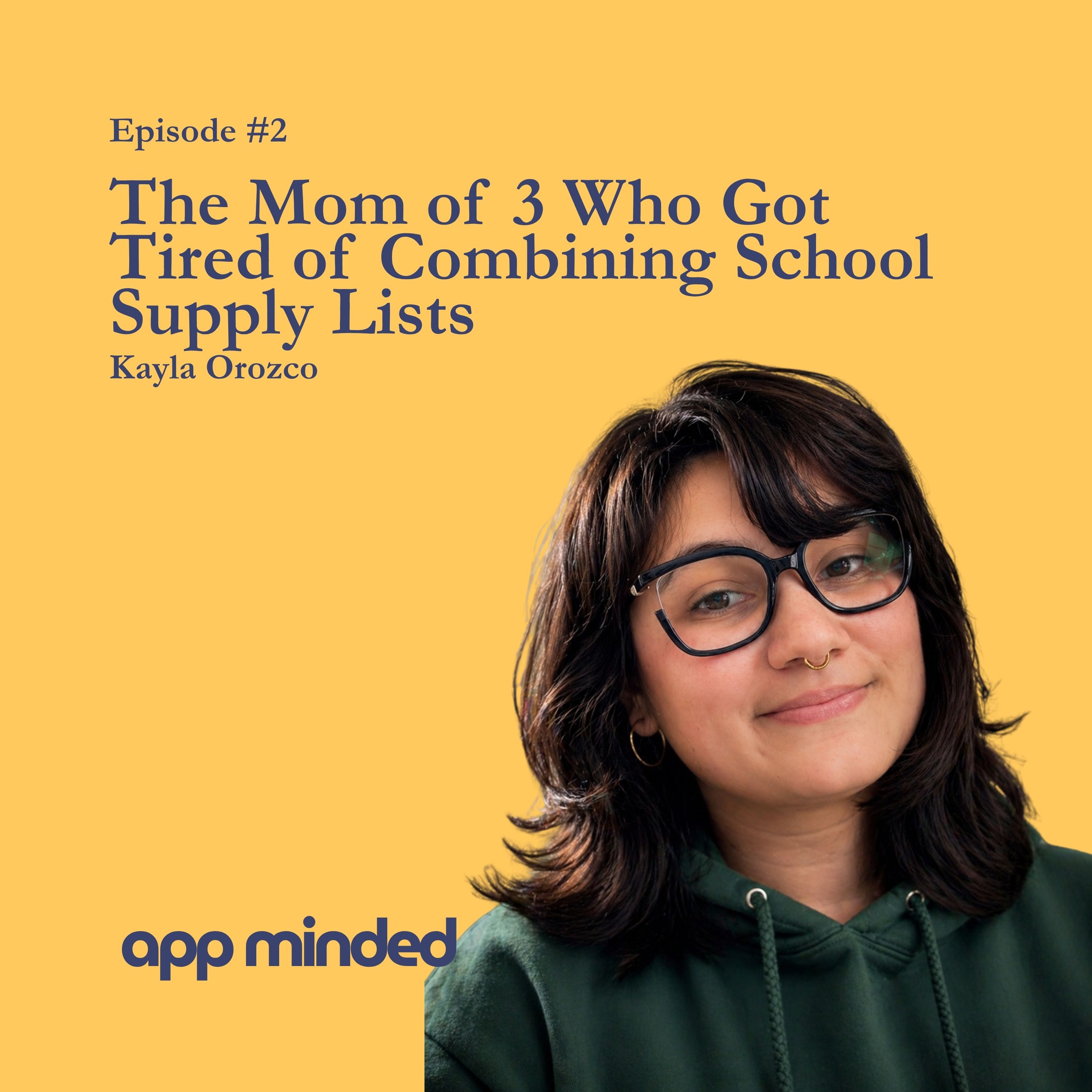
How to Build First App With AI: She Got Tired of Combining School Supply Lists
Kayla Orozco — Conversation designer and first-time iOS app builder. Hosted by Nina Kolari.
Episode summary
Kayla Orozco, a conversation designer with three kids and no coding background, got tired of merging three school supply lists by hand — so she built the fix. Eight and a half weeks later it was live in the App Store. She walks through choosing iOS over the web, using Claude as a thinking partner that pushed back on scope creep, and the mistake she'd avoid next time.
Show notes
Kayla had never built an app before. Eight and a half weeks later, it was live in the App Store.
Every year, three kids meant three school supply lists in three different formats. And every year, she did the mental work of merging them by hand.
She got tired of it. So she built the fix.
In this episode, Kayla Orozco walks through how a conversation designer with zero coding background shipped a real iOS app while working full-time and raising three kids.
You'll hear:
- Why she chose iOS first, and how she decided app over website
- How Claude became her thinking partner and pushed back on her own scope creep
- The one mistake she'd undo (vibe coding everything into a single file)
- Her three rounds of testing, from low-fi prototype to TestFlight beta
- How she handled backend security when Instagram kept telling her vibe-coded apps get hacked
- The two-part pricing model she built, founding member first, subscription later
- What she'd tell you if you have an idea sitting in your notes app right now
Her advice for anyone waiting for the "right time"? Try. Most people never do.
Download her app at schoolsupply.app or search for it in the App Store and PlayStore.
Topics discussed
- Shipping a first iOS app while working full time
- App versus website decisions
- Scope creep and cutting features
- Getting through App Store review
Tools & platforms mentioned
- Claude
- Xcode
- App Store Connect
About the guest
Kayla Orozco — Conversation designer and first-time iOS app builder. Builder of SchoolSupplied.
Full transcript
Auto-generated transcript of “How to Build First App With AI: She Got Tired of Combining School Supply Lists”. Lightly unedited.
speaker-0: So everything that you've done before is not wasted. You can take all your learnings from there and really bring it into that product that you're you're trying to build because you're the only one that has that perspective.
speaker-1: Kayla had never built an app before, but eight and a half weeks of work, she had her first app in the app store. This is App Minded. Every episode I feature a guest who has built something with little or no technical background, solved a problem straight out of her own life. And here is Kayla's story. Hi Kayla, welcome to the forcast. Can you tell me a little bit about yourself? so the audience know who we're talking with today.
speaker-0: Yeah, definitely. So I'm Kayla Orozco. I am a mom of three currently in Texas. I've I mean I pretty much have lived here my whole life. I'm in South Texas, been here for about five years, was in other parts of Texas before that. But I have been working in the AI industry for about the last five years. working as a conversation designer, if you've heard of that title. before. so I basically helped companies implement voice agents, sometimes SMS spots, things like that, people calling in the phone systems for big companies and just helping with that experience that customers would face, sometimes employees for the for the company as well. yeah, that's a little bit about me.
speaker-1: Cool. So y it sounds like you have some experience with AI. So you're not completely like zero technical, but you're not a developer either.
speaker-0: Exactly. Yeah. So I've worked with the AI in my day to day job, but as far as doing something for my own personal life working with it, I had never done it before.
speaker-1: Okay, cool. So but now you have iOS app. Like how did that happen? Where did you how did you even get started?
speaker-0: Yeah. So I had the idea come to me about a year ago. So like I said, I have three kids. all three of them are in elementary school right now. So one's going into fourth grade, two of them have twin boys going into second grade. and you know, like you have to buy I'm not sure what it's like in the UK, but in the US you have to buy a bunch of school supplies every year. it's the parents' responsibility to do that or the guardian's responsibility. And so every year I get three school supply lists from different teachers and kind of in different formats, you know, similar items but sometimes not so similar. And so I would have to do the mental work of combining those every single year. This is my what my third or fourth year now with all of them in school, and I just was tired of it. I didn't want to have to keep doing that mental work of having to combine everything in my head, trying to match items together. It seems simple, but you know, as a mom, you got a lot on your plate and a lot of mental work you're doing in other areas. And so I just didn't want to do that anymore. So I was like, I'm gonna I think I'm gonna try and build an app for this by the next four year. And what March hit and I hadn't started working on it yet, but I started getting it involved in more groups. more AI groups, more webinars, people speaking about what they're building. And I finally felt motivated enough to do something for myself. And I was like, let me start on this app idea that I had. Pushing it, you know, I only had a few months before school started. And so I was like, all right, I'm gonna go heads down on this and start working on this idea for school supply lists.
speaker-1: Yeah. And was it w when you kinda had the moment like I'm gonna build an app, was that the natural or the only choice you had or did you have a list of ideas already at that point?
speaker-0: I had a couple ideas for apps that I wanted to build, but I knew that this one would well, I thought at that time it would have been simpler than my other ideas. And it it still is, but you know, building an app is complicated. There's a lot of different things you have to have to get done in order for it to get approved in the app store. So I I contemplated with Claude on which idea I wanted to pursue first. And so it was like work on this one, this one's simple, and then move to this other idea that you have, which I haven't started yet, but I do want to work on hopefully this year. But it was like start on this one first, it's simple, you'll get your you know, your experience building it, and then let's move on to this next one. So I was like, should I do an app? Should I do a website like for the school supply list? And I landed on the app because most people are comfortable. opening an app that's been approved by these big companies like Apple or Google, you kind of have that trust behind it instead of going to a random website. That works for some people, I just thought I felt better going the App Store route instead.
speaker-1: Okay, that's awesome. And I I think I I agree with you when you say people have more trust in an app than a random website. Are you an iPhone user? That's why iOS was first, or was there an another reason why you chose iOS first?
speaker-0: Yeah. So I did have an Android phone for I don't know the last five or six years, but I kept running into this this year. I was running out of space all the time and it's like, well, I need to upgrade anyway. So I got an iPhone. But I just did some collaboration again with Claude. It was really my thinking partner throughout all of this. Just trying to decide which route was best first. Some people go Android first, but I went iOS first just because
speaker-1: Yeah.
speaker-0: the data behind people buying apps usually is stronger on the Apple. So I was like, well, I do want there to be purchases. Obviously I want it to be accessible to people, so not a crazy amount. Yeah. let me let me start building in the Apple store first. And so that's that's what I did.
speaker-1: Side yes. Yeah, I agree. That's why I also ship iOS apps. So that was my thinking as well. so how did how long did it take you from the idea or the time you decided, okay, I'm gonna build this app and when it was live? What was the timeline? Was it weeks or days or months or
speaker-0: Yeah, it was eight and a half weeks. So that yeah, that was on top of working my full time job, being a mom of three. So if I wasn't doing those things, it would have been faster, but this was, you know, after work on the weekends, just whatever time I had trying to to pour into this app. It took about eight and a half weeks. I remember mid April going to one of the webinars I mentioned and just very inspired and was like, all right. Guess I'm going to upgrade my Claude subscription 'cause I was just on the free plane at that time. It's like it's only twenty dollars a month, so let me just like invest twenty dollars into myself and see where this goes. And it just kinda took off. I got addicted to really it was addicting really, like to like see something be built so quick and like see the results with it and wanna wanna keep giving more to it. So
speaker-1: Yeah. Yeah. I totally agree on the addictive part. Once you create one or kind of get into the like, I can actually do it. It's it's literally quite transforming moment when it clicks in your head and like, my God, I can do this. Yes. Yeah. so what you you've been mentioning, Claude, is that your main coding tool and thinking partner, or do you use any other tools?
speaker-0: It is, yeah. So I I use Claude as my main thinking partner. at the beginning when I was doing like some branding things, trying to come up with logos, I like had thought about mascots, which I didn't end up doing. I had used Claude to build the prompts that I would send to different models, so Gemini, OpenAI, different things like that for other models that had different strengths. Cause I know Claude is not very good. at generating images. Yeah, at least from what I've seen, my experience. So I would use it, yeah, as like my main hub for everything. Sometimes going out to different models to do different things.
speaker-1: Yeah. And did you did you build natively with Swift UI with Cloud or did you do Slutter or some other language?
speaker-0: Yeah, no, I just stuck to cloud code. So I worked in the terminal. It it worked on one of my projects building the code. and I believe, yeah, it's in React native. I I yeah, I stuck with the coding language and structure overall that I could start in iOS, but then I could quickly turn it around and use the same code base also for Android.
speaker-1: Yes. Yeah. And talking about that, the same code base, you mentioned I think you're now already in Android store as well. Or at least you it's not public, but you pushed it to the store.
speaker-0: Yeah, so I've submitted it for review for Android. I did that a couple of days ago, like on the weekend. so I'm just waiting to hear back to see what is left, what I need to correct in order to get that actually approved, but it is live in the iOS store.
speaker-1: cool. So so you have an app that is live on the app store and now you have almost live app in the Android store. Can you talk me to or the process of these two platforms if they if it's just the same or completely different kind of process?
speaker-0: Yeah, overall I would say it's the same. I think the App Store's UI and processes maybe a little bit simpler. I I know that they can they tend to be more strict on what they approve. It's good. Like I'd rather them flag something than a user, like in real life, find something that is messed up. So I do think app Apple's process is a little simpler.
speaker-1: What's
speaker-0: Like it's just a little bit more user friendly. I've had a little more issues in the Google Play Console. I forget the actual name of it. It's something like that. where you go and submit that app. It's been a little bit less user friendly trying to go through different things and where you submit things. but overall, you know, you kinda have to have the same same standards for your app in order to get it approved.
speaker-1: Yeah. Yeah. And how did you even come up with if we go a little bit back into the app and you started building it, did you just one shot like I want this app and boom it was there? Or how did you actually start building it? What was was it in parts or what did it look like when you started actually building it?
speaker-0: Mm-hmm. Yeah. So of course again, like I started just with my thinking partner, Claude, kind of brainstorming on what I wanted to do. I started off with wire frames. So I I had the I had Claude start to put just together some some interfaces for me to look at. And I was like, okay, I like this, I don't like this. And then I went into actually the prototyping, so the vibe coding portion of it. Yeah. Now looking back at it, I wish I would have started with production ready structure instead of just like vibe coding. because the code just gets so big and complicated being in one file that it can be really hard to fix things, at least from what I've seen. so starting off with different components, different files that all work together and is more manageable. I wish I would have done that. Starting off and now I know going into my next app, like that's what I wanna do. 'cause I did have that one big file of code and I had to port it over into the production ready code instead. And that took a couple of weeks itself. So took time away, you know, trying to reach this deadline. So I be yeah I wish I would have done that from the beginning. But yeah, so back to that. I was prototyping. I built a low fi, low fidelity prototype and from there I took it and started testing with users just to see what that experience was like for them, if there were any pain points that I just, you know, didn't catch just with my one brain, you know, other people are are testing it and using it from their perspectives, seeing what issues came up. what would be better in the experience. And after I had that, I had a lot of feedback. yeah from that prototyping session, the usability tests with users, I took all my findings, I made tickets just to track everything. And then I got started on fixing fixing those things and working on the actual branding of the app. that I wanted to do. So all the colors, all the font styles, my logo, and then sort of making the bug fixes, the enhancements, and the branding. So making it more of a real interface that someone would interact with.
speaker-1: Yeah. You mentioned bug fixes and a little bit earlier you also mentioned that you would build it differently. Were the bugs related because you had, you know, vibe coded in everything in one file. Was it those or something new came up?
speaker-0: It was both. Yeah. So some of them being like, you know, it there's some bug in the code because something is just not working well together. Other ones where, you know, maybe I didn't test a certain button or certain thing and, you know, something came up. So it was a little bit of both.
speaker-1: Yeah. How did you fix those bugs? Like what did you do when you found can you give an example of something that happened and then you just had to figure it out?
speaker-0: Yeah, so not like a specific one. There's so many, like little tiny ones. but my process my process was like I saw the bug, I documented what happened, how you could replicate it. And so then I I went to Claude, we did a discovery together. So it made a discovery prompt, sent it to Claude Code. It was like Cloud Chat and Cloud Code working together, but me, you know, being that human in the loop, really monitoring things, correcting where I needed to. it would send a discovery prompt to see what in the code is causing this issue. It would find it and then it would work with implementing the fix. And from there, I would go and test locally on my computer. you can have a little, you know, pop-up of a phone on your computer, which I'm sure you've seen as well because you've worked on apps. To be able to go and fix, you know, test those changes to make sure that they're corrected and then you go and promote to the different environments.
speaker-1: Yeah. what what do you think in the building process was the hardest for you from was it the user experience or what it how it looks like or was it the code or something else?
speaker-0: probably managing all of it. Code, right? 'Cause I don't like I'm not proficient in coding. I know how to direct and like I know the goal that I want to get to. But managing like there's so much that you like you have to do in order to get the thing working, to be up to standards for approval. So just making sure I stood
speaker-1: Like
speaker-0: on top of all of that and I stayed organized so I wouldn't get overwhelmed with just all of all of the things that you have to do to to get it approved.
speaker-1: How did you stay organized with everything that goes with building and shipping an app? Wha was it like a notebook or a to do list?
speaker-0: Yeah, it was a combination of a couple things. So I I had a launch plan, which was just a document of every single thing I needed to work on from getting my prototype so the vibe coded prototype into a production ready and then submitted in the app store. So every single high level thing, but then all of the details of what I needed to do. That helped me personally. Like to be able to check off small things I got done, like I felt accomplished each day. You know, you got that rush every day of right, I got something done. I'm working towards my goal. So I had my launch plan, which was just, you know, a document, a dot dot x file. and then I had my GitHub, so the the repo where all the code was where I could log all my issues and my tickets to track things. So I took my launch plan, I made tickets out of those, and then I started prioritizing what I needed to work on in order to move it in the right direction. So I had my ticketing system and that helped me stay organized. I could work towards milestones. I could work specifically on bugs or enhancements, things like that along the way.
speaker-1: Okay. cool. Yeah, I don't have ticketing system, but I have a notion page that has everything. I probably should consider. I should look into your ticketing system and actually create tickets for myself.
speaker-0: Yeah, I didn't even know it was there until I talked to one of my friends who's also making an app and she's like, yeah, like I just I have all my issues there in GitHub. I was like, I should use that.
speaker-1: Yeah, yeah. Cool. what about since you're not technical, how did you start prompting? Like did you have a structure or did you just I wanna build this app? How did you come up with the prompts or were the prompts even important in your process?
speaker-0: Yeah, so I did I do have experience in prompting because for conversation design, it is what you do. So conversation design originally well originally it was like press one for this, press two for that, and then it went to NLU, if you've heard of that, which is like the brain, you build intents and when people say something it matches to an intent. But then you had the whole agentic shift.
speaker-1: Yeah.
speaker-0: working with the LLMs. And so in my job, I I had to learn how to build those prompts for the LLM to be able to create this voice agent. So I did have experience in that. And so taking that experience, I applied it with the app that I was building. So I made sure my it wasn't perfect every single time. Sometimes more it was just talking back and forth with Claude.
speaker-1: Yeah.
speaker-0: But starting off with what my goal was in that original prompt, maybe if there's an issue that I saw, how what we need to do to fix it, and if could give me like specific things that I'm looking for to help me, you know, accomplish that task.
speaker-1: A lot of the app builders I speak with, they kinda get the scope creep that they the app is never good enough or finished enough for the app store. How did you manage the scope creep in your building process?
speaker-0: Yeah. that came up a couple of times actually, where I would have this idea and I'm like, like I want to work on this thing. And so I would bring it to Claude, like, hey, what do you think about this? Like, is this something that we should work on to get it done? And it it actually would push back like, Hey, you have this launch date that you're trying to hit. So it was aware of what my overall goal was, like, and so it would push back, hey, I don't like that's a good idea, or maybe that's a bad idea, don't do it. but if it's a good idea, like maybe let's let's ticket this for version one point one. You know, so work on what you need to get done in order to get it launched before school time. All of the other ideas, log it as an enhancement or for a different version. that way you can really get your app shipped in time for your launch date.
speaker-1: Yeah. And did you also include like beta testers at some point and were they kind of giving feedback on is this enough or do should you add more?
speaker-0: Yeah, so I had three rounds of testing. So I had one where it was at low fidelity with users seeing what their their feedback was there. I updated my app, I put the branding in, had all the colors, made it really nice, and then I did another round of testing there just to get some more final feedback. And then I had it in beta testing, so a completely different environment. You know, you move it to your local dev staging production. Sorry. And so when I I had it in staging, which is in test flight for Apple, you're able to then just send a link to someone who has an iPhone to be able to go and download your app from test flight. And so I had beta users there. With that, I tried to make it a little bit more formal process because I wasn't moderating the test like I was in the first two rounds. So I made sure to have a document kind of walking those beta testers through what the app was, what the goals were, and then different test scenarios they could test for the app. and then a link for a form to provide feedback. So what what issues they saw. what they wish would have been there, things like that. so I I had that process set up for them for beta testing.
speaker-1: Okay, cool. And what kind of features or did you add any features based on the beta test? Or did it actually ship as is and just everything or the ideas went into the next version?
speaker-0: Yeah, so some of the ideas went are going into the next version, but there were like there was a a bug, or not really a bug, but an enhancement I guess to just the the simple onboarding flow. So I have my paywall that comes up for your second kid. You know, if you have one kid and you wanna add i items manually for the school supplies, that's free. But once you start adding multiple kids, you know, you have to merge your lists, you know, you have the option to scan the school supply list, things like that. So it's little more tech heavy when it comes to to that. So that's where the paywall pops up. So it was a little confusing on where it was an experience. And she gave me feedback on a specific button. She was like, Well, it shouldn't be once you're finished. setting up the second kid's profile and press next it should be before that when you want to add the second. You know, so I just completely missed that. And I was like, yeah, that's a great point. That's something I need to get in for production users, because that will affect the experience overall. And so I got, you know, something like that fixed before actually having the production app approved.
speaker-1: Yeah. You mentioned the paywall there. when you started building, did you knew that it's gonna be with the paywall or did you even think about the paywall when you started?
speaker-0: like I said, I I wanted to keep it accessible. not like pay thirty dollars a month for this thing or twenty dollars a month. and so I knew like I wanted to monetize in some way. Yeah. Because I am trying to build, you know, different sources of income. Like for me, you know, with all these different apps I want to build, and I know it has value. So I I knew I wanted to, I brainstormed with Claude on what my plan was gonna be. so I came up with like a two part payment structure where I'm starting off with the founding member price, you pay at one time, you get the app forever. So you have kids, you know, you get to use it for thirteen, fourteen years while they're in school. You get access to all the features. But once I start putting in enhancements that are past this initial scope. It'll then turn to the subscription. so founding member price, you're we're past that window, now we got a subscription, which will still be accessible because I don't want it to be like I want it to help parents, you know. and be at a a price point that is doable for a lot of people.
speaker-1: Yeah, yeah, absolutely. You have mentioned a couple of times that you also have other app ideas. do you have a long list of ideas or is it like just a few ideas?
speaker-0: a long list maybe in terms of how long it'll take to do all of
speaker-1: Okay. Yeah. Yeah.
speaker-0: But I I'd say I have maybe like three or four more apps that I I have on my just on my phone on my notes. Like each time I get an idea, I'm like, I'm gonna write that down so I don't forget and you know, maybe it'll be the next one that I work on.
speaker-1: Are are those ideas you don't have to go into details, but all are are those apps also something that fix a kind of problem or issue in your own life? Mm-hmm.
speaker-0: Mm. Yeah. So from personal experience, different things I've I've encountered. I'm like, surely I'm not the only one who's had issues with this. you know, so of course whenever I have those other ideas, I'll start off with maybe some research, really seeing if it is a big pain point for people and if it's worth pursuing.
speaker-1: Yes. Yeah. Yeah. Do you have a indic like indication or have you come up with something when you know it's worth proceeding or not?
speaker-0: I think that's where the user research really comes into play because I can think it's a really great idea, but other people may not think that or they may not, you know, have the same issue. So one, making sure you're doing that research in the right groups of people. So like me, I'll go ask parents, I'll make a survey, post it in Facebook groups like for parents, things like that to really see what their perspective is. 'Cause you don't want to just like I'm not gonna go ask someone who doesn't have kids like, Hey, what do you think about these? You know, they may have insights of other ways about like the user experience, but when it comes to the actual problem, making sure you're asking like the right people to get their perspective.
speaker-1: That is very important. Actually asking the right people because asking the wrong people often might actually discourage you and it's like, why am I even doing this? So finding the right people is very, very important. so with all that, how how how did it feel when your app actually went live at the app store and you could be saying like, Hey, this is my app, like it's live for everybody to download. How did that day go?
speaker-0: Yeah, it's surreal. Like, I can look at my phone and that's my app. Like, that's crazy. I have told my husband, like, even if it flops, like I'll still be proud of myself for actually getting this work done, you know, to be able to to have something approved by Apple or by Google that will be downloadable by anyone, you know? Yeah. so it was it was really a crazy moment, I think. Exciting moment. Celebratory moment, yeah.
speaker-1: Yeah, yeah, absolutely. It's not it's not easy to go to go all the way from idea into the app store because there's so many hurdles that you have to come across or get over while you build and ship. so what happened now it's live in the app store, what has happened since?
speaker-0: Yeah, now it's live. I I've had a good amount of downloads. I've had some people purchasing the app, which has been great. Yeah. I think the conversion rate I was just looking at it was like twenty eight percent, which apparently is
speaker-1: Excellent. That is really excellent.
speaker-0: I like brought those numbers to Cloud. I was like, hey, like, what about these numbers? Like I that's really low. And it's like, no, that's actually high. I was like, okay. sorry. So I was like, okay, that's encouraging. I've found that when I am marketing more, obviously, like making posts about my apps, you know, the sign ups start to go up a little bit more. So I've been trying to do that, but Yeah, so I've I've had good amount of downloads, some purchases being made. I'm sure it's a little scary, like, like eight dollars, like do I want to pay that? But you know, maybe parents, you know, before school starts, like, okay, I do need this app, I'm gonna buy it. Yeah, I'll have it for the rest of my life. So but I also have like crash reporting in my app, monitoring to see if there's any bugs or anything coming up. So I've been looking at that every day. just to see if there's any issues that I can kinda tackle for the next version.
speaker-1: Yeah. Have you since putting it live to the App Store, have you pushed any updates or fixed any bugs since the first initial launch?
speaker-0: Yeah, so I actually just pushed my first update yesterday. It went a lot faster than the initial approval. So yeah, once you have your app in the app store, those approvals or reviews, you know, can still get denied. Goes a lot faster than the first time. So yeah, I fixed some bugs that were there and then I also added Google sign in.
speaker-1: Okay, excellent. Yeah.
speaker-0: to the authentication page. So before it was just the email password and Apple sign in and now it also has Google sign in.
speaker-1: Okay. Yeah. are you tracking analytics of your how it performs in the App Store or how people are using where the users are coming from?
speaker-0: so I don't have like Googling Analytics in the app. I have it on my landing page to be able to track like where people come from. So not not in the app just yet. but I am monitoring that other things like you said, if there's crashes, if there's any bugs that come up, things like that.
speaker-1: Yeah. you mentioned website. did you also vibe code the website?
speaker-0: I did, yes. Yeah. So I got that ready. That was one of the first things I did because I wanted to be able to have a wait list for people to go and sign up and a page explaining what it is, having the wait list sign up and then, you know, follow me on TikTok or Instagram to like get updates as well. So and of course that's where like the privacy policy and terms of service things like that are hosted at.
speaker-1: Yeah. Yes. Yeah, you can't get past Apple's reviews before those. Yes. Yeah. Okay, cool. So if you had to rebuild the app again today, what would you do differently now that you've gone through the cycle of one time?
speaker-0: Mm-hmm. again, I said it like I would start with the production structure first. it may be a little slower, but not having to deal with porting everything over to that new structure to make it manageable. I would definitely do that instead. like of course if I could do more user testing, like More is always better. Yeah, maybe I would do a little bit more of that this next time.
speaker-1: Yeah. Yeah. Yeah. You mentioned production structure. if somebody's listening here and they're like, what does that mean? Can you explain a little bit what it like I remember you mentioned in the beginning the first initial version did not have any and the second one did. So what was different in those two code bases?
speaker-0: Yeah, so with my like five coded prototype, and maybe people do it differently, but for me starting off like, hey, I have this idea, I need it to do these things, it just starts off in one file. and so you can have thousands of lines of code, which is really, really hard to manage. So if you were to ever bring someone on, like a coder, an actual software engineer, they might struggle trying to figure out what what is going on, where to pinpoint, what to fix in that code. and again just just becomes kind of unmanageable, especially as you continue to add features, enhancements to your code. maybe you fix something down here, but it might break something up here, right? And so I transitioned that to a production ready code where it's actually broken into the structure that it's supposed to have, at least again, for my limited knowledge.
speaker-1: Yeah.
speaker-0: of coding, but I I talked to Claude about what I wanted, like I wanted it to be manageable and for an engineer to be able to come in and help if needed. So it basically just broke down the one page of code into multiple components that would work together. Right. So you like you have your bottom navigation, you know, and so the code co calls those specific pieces of code or portions of code to be able to make all of it work together.
speaker-1: Yeah, yeah. in the before we started this recording, I asked you in a forum, like a couple of things on your background, and you said something like, non-traditional background is an asset, not a gap. What do you mean by that?
speaker-0: Yeah. like I I started in tech five years ago, you know, so before that I was working as like a social media manager at a nonprofit, you know, so people people can transition from a any career into tech, into building, you know, these apps and you have your your valuable insights and transferable skills from where you're coming to be able to help inform. form decisions and things that you're building now. So everything that you've done before is not wasted. You can take all your learnings from there and really bring it into that product that you're you're trying to build because you're the only one that has that perspective. You know, so there there's a lot of value in that.
speaker-1: Yeah, I totally agree. And I think women particularly are in in great position. I've spoken to so many women who can literally they don't maybe realize that they're actually app ideas, all of them. Issues that they come up, but many of them could be easily turned into an app and monetized because there's other women who face the exact same issue that they do. So and I think that's one of the best part of doing mobile apps is you can sell globally. I don't know if you're selling globally or if you're selling just in the US.
speaker-0: Yeah, I just have the US now, so that was my scope. I knew if I went into other countries first I would have to make sure I hit certain legal standards, right? With Europe you have to have the G D PR is that
speaker-1: Yeah, yes, yes. Uh-huh.
speaker-0: So making sure like all right, I have it covered here in the US. I know what I need to do. post launch I do want to expand into other countries, but again, that was out of scope for that initial launch that I had.
speaker-1: Yeah. Yeah. Have you thought about translating to other languages? Or maybe you have already?
speaker-0: I having, yeah. I that would be really interesting in how the experience would work 'cause I don't know, you know, l other languages and so I wanna I would wanna make sure I get that right if I were to translate it.
speaker-1: Yeah, I've translated my apps and I highly, highly recommend it. Especially in US, Spanish market is untapped. So I highly recommend that. Considering I got my first sale immediately when I translated into other languages. So definitely good to know that. Yeah. So you built now one app. What is next for this app? And or are you gonna move into the next app?
speaker-0: Yeah, so first I'm gonna keep working on this app. I have quite a few enhancements that I wanna do, which will actually move me into something being valuable enough for having a subscription. Right now it's just like a a very specific time period in the the year when school is about to launch for getting those school supply lists. So it's valuable for that, but not worthy of hey, I'm gonna pay all year round for this thing I'm gonna use for one time. So I want to work on enhancing my app so it is valuable enough for parents to pay, you know, a couple dollars a month throughout the year. So my plan is to work one, work on some of the tech that that I have for the app, but then also work on those enhancements to make it subscription worthy for parents. So one of the things I want to work on is like using the tech that I already have built into the app. that is scanning those school supply lists to also take that to forms parents get. with you know, your kids being in school, you they come home with papers all the time. Yeah. So all three of my kids will come home with papers stuffed in their backpacks or their folders from their their teachers about different events that are coming up, maybe forms they need to fill out. So using that same technology to create notifications for parents, you know, to to s intelligently extract that information from the form and then use it with their calendar.
speaker-1: How are you extracting that information from the school list or any kind of papers they come with? How how does that work?
speaker-0: Yeah, so it's a two-part thing. on iPhones, it's using Apple Vision. And then on Google or on Android phones, it's using like an ML kit is what it's called. Same, same tech, but basically it's you've probably seen it when you try to take pictures of things. It might have the little like squares or like corner pieces pop up around text. So that's what it's doing. It's extracting the text from the papers. using that built-in functionality on the phone already and then I am using AI to be able to parse that information and structure it to send to the the back end where the tables are actually stored.
speaker-1: You mentioned AI. Do you have any cost, like monthly monthly cost to run this bus app, or is it completely free for you to run?
speaker-0: Yeah, I do. So I'm on a like I'm on pay versions for things, but until you have like thousands of users, it really it doesn't cost anything just yet. for the specific AI functionality, it does have a cost, but it it's very minimal until people are like, I'm gonna scan like fifty things, you know. So yeah, so there is some cost there, but it's built into the the pricing that I already have.
speaker-1: Well, yeah. Yeah. I I've heard that many struggle with A is the AI integration and the cost. And one of the costs comes from database and especially database security. I think you have you have a back end, right, with the database. So how how did you tackle a building it and then securing it?
speaker-0: Yeah. So that was something that I wanted to really make sure that I got nailed down. you know, I'll I'll be on Instagram or TikTok and you get these like, you make sure your vibe coded app doesn't have these things or you're gonna run into security issues and I'm like, crap, like not really you know, like it's kind of scary like creating those things. So I made sure that you know, users can only access their information. They can only change their information. Yeah. And actually in some of the tools you have like these testing playgrounds. And so I made sure to utilize that within the actual platform to be able to play around thing with things and make sure that the the like rules there were set up correctly.
speaker-1: Yeah, yeah. It is a a whole whole nother area of building apps. But it's it's doable with AI, I think. I generally think so. So overall, how if you a ballpark number, how much do you think you spent money in building this app and maintaining the app? From the idea when you started and then you get the Claude. How much money do you think you've has spent in the last few months?
speaker-0: Yeah. like total starting my business because I had an I started an LLC just to make sure I had that legal backing behind me as well. So that I filed a trademark, which you don't have to do, but that was just something that I wanted to do. so total it was a couple thousand, but that was with starting my business, you know, doing things like that. You have to pay the LLC fee. but it there's one time fees you have to pay as well. Like for for me for legal docs, what I did was termly. yeah, so I did that just to have something solid with you know, I could just configure it for what I needed to and it would build this giant yeah document for me. So there's some some one time fees you have to do, right? So that was like a hundred dollars for the whole year. you need the Apple developer program license, which is $100 for the whole year. and I I'd say monthly, like if you think of that with the other subscriptions I have, maybe fifty dollars a month. So not too crazy, right? For for building an app in a lot of those things you can bring into your other ideas that you start to build as well, like the Apple developer program is a one time fee or not a one time, it's you pay it for the whole year, but it's not specific to that one app. So you can start to bring that and use it for other ideas.
speaker-1: Cool. So to wrap up, like what is future for Kayla and your apps? Are are you gonna be like an app entrepreneur next year or something? What's what's the goal with this?
speaker-0: Yeah. So yeah, the first one was really just to bring my ideas to life. You know, I finally have a way to to actually do that. and I I do want to expand those apps that I have and, you know, start bringing those other ideas to life. So I I I love my job where I'm at now. So hopefully my employer is like, What is she gonna do? You know. So I am I am doing this like on my own time, trying to to build these ideas out and So maybe it'll go somewhere, you know, maybe I'll I'll have this extra income coming in. But I've really I really have loved having just the ability now to bring my design ideas to something that is actually like tangible in people's hands, you know, on their phones. So
speaker-1: And and with that, you love the experience creating something, you know, out of nothing nothing basically. What would you say to somebody who's now sitting there and listening to this like, Well, I actually have an idea. What what should I what should they do first?
speaker-0: Try. Like just just yeah, just get started. Like you will most people don't try. So try, bet on yourself, and maybe it'll be the next like top selling app or piece of software, you know. yeah, start with your idea, start brainstorming with whatever AI system or whatever tool you want to use, whatever works best for you, and just start.
speaker-1: Yeah. Awesome. So people want to l learn more about you and the app that you built, where they can they find you?
speaker-0: Yeah, so you can find me. I'm on LinkedIn, I'm on Instagram, on TikTok, just search Kalo Rosco. you can also, my app has again those pages as well on LinkedIn. I'm not as active with like the school supplied app on LinkedIn, it's there. but I do post about it on Instagram and TikTok, and then I have my my landing page, which is schoolsupplot.
speaker-1: Awesome. Thank you very much for your time today and I wish you all the best with the apps.
speaker-0: Of course. Thank you for having me.
speaker-1: Kayla is a perfect example why I wanted to create this podcast and feature women who are building with very little or no technical background and taking their problems and issues from their own life and turned them into an app for everybody else to use. And that is a wrap for today's episode. Huge thanks to Kayla for sharing her story. If you are a parent trying to survive the back to school rush, Go download her app in schoolsupply.app or search for it in the App Store. I'll also link it in the podcast website. If you loved hearing how a fellow mom turned her everyday headache into a live app using AI, follow and subscribe. We have a whole season of founders coming your way. Until next time, keep building.
More App Minded episodes
- Building Apps with AI: What I Learned Along the Way
- How To Build A Thrifting App With Claude And Replit (No Code)
- How to Build an App With No Coding Experience Using Lovable and Claude — with Christina Moore
Browse every App Minded episode or read more about the podcast and Nina Kolari.