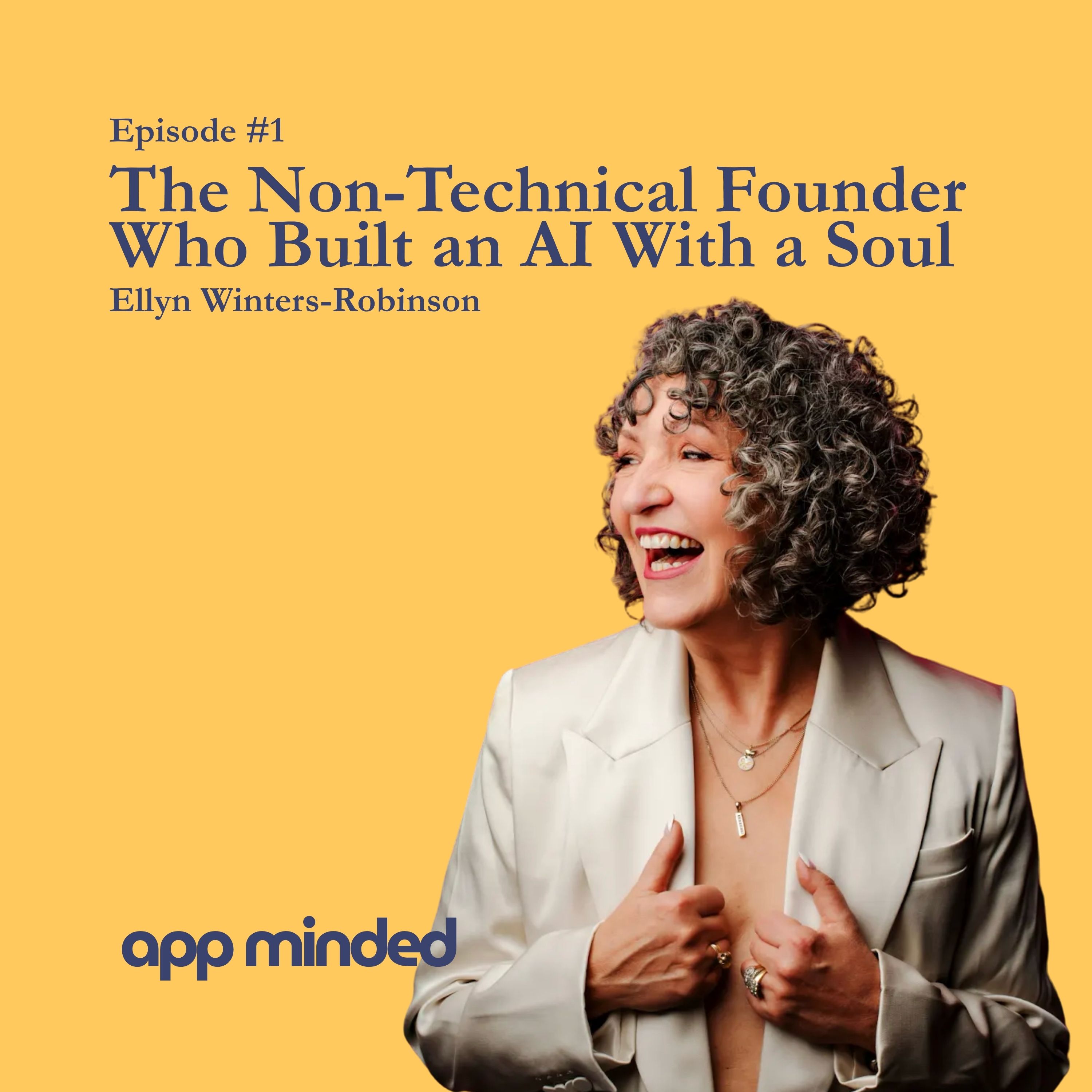
The Non-Technical Founder Who Built an AI With a Soul
Ellyn Winters-Robinson — Founder of AskEllyn.ai, author and tech marketer. Hosted by Nina Kolari.
Episode summary
Tech marketer turned breast cancer patient turned founder, Ellyn Winters-Robinson built AskEllyn.ai — an AI companion for people impacted by breast cancer — without a technical background. She talks through shaping an AI product with real empathy, validating it with patients, and getting it in front of the people who need it.
Show notes
Ellyn Winters-Robinson — tech marketer turned breast cancer patient turned founder of AskEllyn.ai, the first AI companion for people impacted by breast cancer.
Ellyn Winters-Robinson spent her career in tech marketing — until a breast cancer diagnosis exposed a gap she couldn't ignore: patients get world-class medical treatment but almost no support for the emotional, day-to-day reality of the disease.
So she built it herself.
In this episode of App Minded, Ellyn shares how she went from patient to founder, building AskEllyn.ai, an AI companion designed specifically for people impacted by breast cancer. We talk about the neglect of women's health, why patients are becoming builders out of necessity, and what it actually takes to turn a personal crisis into a product that helps thousands of others.
If you're curious about AI in healthcare, women's health innovation, or how founders build from lived experience, this one's for you.
Topics discussed
- Building an AI product without coding
- Turning a personal problem into a product
- Designing an AI companion with empathy
- Marketing a health-adjacent AI product
Tools & platforms mentioned
- AI chat models
- No-code and AI app builders
About the guest
Ellyn Winters-Robinson — Founder of AskEllyn.ai, author and tech marketer. Builder of AskEllyn.ai.
Full transcript
Auto-generated transcript of “The Non-Technical Founder Who Built an AI With a Soul”. Lightly unedited.
speaker-0: that is very much needed for the individuals, the patients that are going through this thing, but again, is never going to be solved. And so I'm really excited about, you know, these tools not only are helping people that go through a healthcare crisis understand what they're doing or what's going on with them, but they're what's happening now is you see patients becoming builders.
speaker-1: Hi everyone, I have a really special guest today and I would actually like you to introduce yourself and let the audience know a little bit about yourself and your journey.
speaker-0: Yeah, sure. I'm Ellen Winters Robinson. I'm a Canadian. ⁓ I am a lady who had breast cancer. ⁓ unfortunately, one in eight women will be diagnosed with breast cancer in their lifetime. I was diagnosed four years ago. ⁓ prior to that, I was a marketer in the tech space, ⁓ marketer and advisor in the tech space. And ⁓ the diagnosis ⁓ subsequently led to the creation of something called Ask Ellen. Dot AI, which is the world's first AI companion for individuals impacted by breast cancer. And so I've suddenly become not just a marketer to the tech world and to tech founders, but I am now a tech founder myself. And so it's been a really interesting journey.
speaker-1: Yeah. I I I can't wait to hear it. There's a couple of questions ⁓ later that I definitely want to talk about how the empathy and AI and all the rest of it, but before we get there, yeah ⁓ can you can we just go all the way to the beginning? Like this was not in your bingo cards in any way become an app builder and everything, but it started with the diagnosis. So if we go all the way there.
speaker-0: Yeah, sure. So that was ⁓ it's it's crazy how these dates are just burned in your brain. So it was March 10th, 2022. We were just kind of coming out of COVID. And even prior to that, I had found a lump in my breast in January and sort of sat on it for a few weeks and it wasn't going away. So I went to my family physician. It was actually weird. It was the first time we had ever met because she had just taken over the practice and she had referred me for a diagnostic mammogram. And so that's was March the 10th. And so I went to the clinic and had a ⁓ mammogram and then they do an ultrasound as well. And I left and grabbed lunch and I I was on a call with a client and about four o'clock in the afternoon my phone rang and it was my doctor's office. And ⁓ unfortunately they we didn't connect with each other and so I pretty much learned I had cancer through a voicemail.
speaker-1: Ooh, that must have been tough.
speaker-0: Yeah, it was ⁓ it wasn't fun because my doctor on the voicemail says she wasn't gonna be in the next day. It was a Thursday. Like these again, these dates like dates are burned in your brain. And so I just remember running upstairs and literally like hiding under the covers. Yeah. And I didn't get to speak to her until Monday. and so I knew, I mean, I knew based on you know what she said on the phone that this was not gonna be good. Yeah. So yeah, it was it was pretty agonizing.
speaker-1: Yeah. So from from the moment you got diagnosed, then you get into treatment.
speaker-0: Yeah, there's a there's even a gap between that. So so you hear in the voicemail that you've been diagnosed with cancer, and then I spoke to her and confirmed that on Monday. And then there was this is the Canadian healthcare system, but there was a four week wait ⁓ until I could see a surgeon and have a biopsy. Yeah. Because there's different types of breast cancer. So when they when they do a biopsy, they're really trying to identify what type of cancer you have because there's different variations. And That four weeks was absolute hell, absolute hell. Like I lost 10 pounds in four weeks. I couldn't do anything. I was just paralyzed. I would sit on the floor just trying to get a breath. Like I felt like I had just been like punched in the gut and just had all the air sucked out of me all at once. And I had panic attacks. I was running around with cold packs on my chest. ⁓ I couldn't eat. I, you know, was just It was it was just horrific. I did have the foresight to ask my doctor for some some ⁓ anti-anxiety meds. So I started taking those right away. but yeah, that that that period of time, I remember thinking, God, I I feel so alone, even though I knew that there's a lot of women out there that have breast cancer, but it's you know, it is a very isolating experience to be in. And there's just no support for you in those early days at all. So yeah, so you know, and then have the biopsy and then you have to wait another there's a lot of waiting in cancer diagnosis and so there was another two week wait before I saw the surgeon and then it turns out I had three tumors in my left breast and so they had to then do an MRI. ⁓ Yeah. And so ⁓ we had to wait for that. So I didn't actually have surgery until the 31st of May. So yeah. Yeah. And then they were still not certain whether I was going to need ⁓ any additional treatment but
speaker-1: Yeah.
speaker-0: After surgery, they had determined that ⁓ I had some micrometastases to my lymph nodes. So I had two of the three lymph nodes that they checked were had a little bit of cancer in them. So at that point they decided that I should do chemo. So I did chemo for twelve weeks. Twelve weeks, three, four months, four months of chemo. Yeah. ⁓ and then ⁓ and then radiation after that. So it was all told probably about two hundred and almost close to three hundred days of my life. Yeah. We're you know, basically in the healthcare system going through this. So
speaker-1: Yeah. Yeah. And ⁓ what I read ⁓ from the questionnaire that you filled in before is like the medical side or the doctor side was okay. Yeah. Whereas a human was kind of forgotten. Like the human behind the disease is like w there there's nothing for that one.
speaker-0: There's there's nothing. ⁓ you know, it's ⁓ I always say and I'm find myself now at a lot of medical conferences and I'm like the the human aspects of the diagnosis are out of scope. Yes. Like they're they're just so fixated on treating the disease, cutting the disease out, killing the disease. And yeah, the medical care is fantastic and I had great care. But you get like ten minutes with your doctor and the doctors are pretty detached for the most part. They're not there to answer questions like, okay, I'm know what's gonna be like when my hair falls out and so I kept turning to other women that I knew who had been through this and they were giving me all this wisdom that just wasn't they it wasn't things it was important to me but it wasn't important to the doctors, you know, in the course of my treatment. And so, you know, what I've learned is that's that's pretty true, you know, across the board. Like, and there's nothing for caregivers. So there's nothing for the family members. So you know it's kind of You know, the you're as a matriarch the family, you know, you're like going through this cancer thing, you're like terrified, and you're having to kind of reassure your kids and my husband and and you know, because we're all on this trauma bus together. So it's a it's a really missing component that you know, ⁓ I don't think the healthcare system thinks about. And it starts earlier than the treatment and it continues on afterwards. So I'm four years out from a diagnosis. I've just finally found a trauma therapist who specializes in medical trauma. And all she has to do is say a couple of things to me and I'm like bawling. So it's still all in there, you know? and that's true of I think of anybody that goes through a a life-threatening illness.
speaker-1: Yeah. So how at the time you didn't have the support. What did you what did you do to get some support? What was your solution for yourself?
speaker-0: I did a I did a lot of phoning of friends. ⁓ I did a lot of conversations with people. I joined support groups on Facebook. but I pretty quickly retreated from those groups. So peer support is tricky in cancer because everybody in there is suffering from trauma. And and so it's very it's it's there's a lot of collective trauma happening. Like I remember joining because I was terrified of a biopsy. And then I had some people tell me, like, I don't know, it's like pregnancy. They like to kind of get on the phone with you and tell you like the worst case scenario situation. Yeah. Scare your crap, scare the crap out of you. ⁓ so I I did that and I had supporter calls and I had ones that were very scary. And then again, the trauma, you know, the trauma of these groups was just too much. ⁓ there's too much emotion. So I pulled out of those because I was just it was it was making me more scared. You do a lot of Googling.
speaker-1: Yeah.
speaker-0: Yeah. ⁓ which is not also good because you're going down a whole bunch of rabbit holes. You know, I remember like looking at, you know, what's my life expectancy and yeah, what you know, you and you just you're thrust into this world that you've never really even thought about. I said it was like I was having to go to cancer university. I was having to learn terminology. I was having to like figure out what matters, you know, people talk about stage and type and You know, all these things that I just had no idea. I bought Dr. Susan Love's breast book. I read that from cover to cover. So it was just all the analog things that I was doing, all the sort of traditional supports, none of which was great.
speaker-1: Yeah. Did you dabble into using AI as like in some form like did you chat with ChatGPT or Claude or something like that?
speaker-0: Well, it interesting because my diagnosis kind of predated Chat GPT coming into the world. Yeah. So there was nothing, like there was no AI at that point. ⁓ so it was very much the the analog. That didn't come until a year later. Yeah. And so, you know, I'm kind of like on, you know, with what I've done with the AI was a little bit on the bleeding edge of agentic AI. I mean things are moving very quickly, but yeah, so that didn't exist.
speaker-1: Okay, yeah, yeah, yeah. Yeah. Yeah. So ⁓ so you had this experience at w which point what happened on the day you decided like I'm gonna do something about this? I didn't get the support but what can I like what can I do?
speaker-0: And it was it was it was a it was it wasn't really sort of one aha moment. It was kind of a progression of things. So I think the it it started with me making the decision that I would share my story. I think that that has to that has to be the first place, you know. ⁓ and that started not long after my diagnosis. I actually took to Facebook and I had, you know, shared with my friends that I had had this breast cancer diagnosis and There was an aha moment there because I remember 17 of my friends all said, you know, we're gonna go for mammograms because you know, because for you, Ellen, you know what? You're brave, you shared your story, we're gonna go. And of those 17, two of those women were diagnosed with early stage breast cancer. And I went, ⁓ my vo my voice, my story matters. I've been able to basically, and one of them is a very good friend of mine, and she said, You saved my life.
speaker-1: Yeah.
speaker-0: Because she said she wasn't going for mammograms and she wasn't checking her own breast. So, you know, so she was in shock. so that happened. And then I'm a writer, so that's my profession. And so a friend of mine said, You should share your story, you should write a book. And I thought, I never thought about writing. Well, I guess I have, but I didn't know what I would write about. Yeah. ⁓ and so I had all these stories compiling in my brain. And so while I was in chemo, I actually started writing the book and I thumb typed it on my phone and ⁓ just hicked up on steroids and everything else that they give you. And I remember seeing my oncologist at one point, I told her I was writing this book. And I said I'd literally run out of material because I had told the story right up to that point.
speaker-1: Yeah.
speaker-0: And she said, ⁓ we'll give you more material. So I had written so I'd written the book and then I kind of finished it. When I finished radiation, I kind of thought, well, that's a natural place to kind of end the book. And my intention there was that somebody could have this book and that it would give them comfort that there was another person that really understood their journey. And it's been really nice. Like the book is out there on Amazon. And I'll I'll get a woman every now and then who'll like post on Instagram and say, I'm reading this while I'm in chemo. And that makes me feel good, you know. And it does, and they people will say it feels like I'm you're sitting right beside me. You understand what I'm feeling. And I also love that they give it to their husbands to read because it does give people a picture of what's going on inside the brain of somebody who's been diagnosed. So I wrote the book, and then it was actually about a year later. So then Chad GPT came out, and then I ended up bumping into a fellow who's in the tech world, and he was really intrigued by. ⁓ my story and I sent him my book and he kind of went into a fever dream. Again, I'm not a builder. So he actually is the one who built the first version of Ask Ellen. And I remember him starting to send me back responses. And I've and I sent them to my daughter in law. And she said, ⁓ my God, it feels like I'm talking to you. And so then we kind of banded together. So these got these 35 year old guys who, you know, found this lady and thought That her story could be turned into an agentic AI. And so we all kind of came together and started just, and it was really just it was kind of getting together and going, okay, well, let's see what we can do here. And we didn't really think it was going to be anything extraordinary. But I remember sending it to a clinician, a woman who runs breast imaging at a Toronto hospital. And she emailed me back. She said, How soon can I get this? And it was that point I was like, we've built something here that really matters. And then the story's just kind of blown up since since then.
speaker-1: Yeah. So you went from having a diagnosis into like a tech founder. That's a pretty pretty good mark.
speaker-0: Well, yeah, and it's it's a it's a tech founder. ⁓ you know, I mean, I'm kind of a lunatic now because I just believe so so clearly that there's a need for this. And and we've also now received a quarter million dollars in research funding from the Canadian Cancer Society. So we're now partnered with researchers at Brock University. and so we have a national, it'll be the biggest ⁓ study of its kind because there's really not a lot. There isn't any. There isn't any. study that really looks at patient AI inpatient hands. And so this is the first of its kind. and she has plans for more research. So we all have clinical evidence by the fall, which if you're even in health if you're even healthcare adjacent, clinical evidence is just how that scientific community rolls. So yeah, so now I'm like my name's on research papers and
speaker-1: Mm.
speaker-0: So it's just it's it's very, you know, I'm getting asked to speak at AI and medicine conferences and I find myself on panels because apparently in the medical world I'm doing something that's kind of bleeding edge. So it's it's very silly.
speaker-1: No, I think it's amazing. I think that's the beauty, I think, with AI and all the rest of it that we only scratching the surface surface still. And what else can come up with personal experiences and people starting to build from there what's happened then either in life or work? Like it's completely I'm amazed every time I hear somebody's idea. I'm like, but of course. It just makes so much sense. And it's like why nobody did this before.
speaker-0: Yeah, there's, you know, so there's a there's ⁓ re ⁓ economist ⁓ researcher at University of Waterloo who talks about phases of AI. And so we're still in pretty much phase one. Organizations, enterprises are still very much in phase one, which how can I use AI to automate a process or take a human out of the loop or whatever? It's kind of operational efficiency kind of thing. But he said the next phase of AI is this reimagining. And that to me is what really gets me excited. And that's I kind of leapfrogged over because ask Ellen, there is no there's nothing. And the system will never, the healthcare system will never solve for that human side of a diagnosis. They never will because it's just not they just don't have the resources or the capacity to do it. And so I've sort of stumbled onto this space that is very much needed. for the individuals, the patients that are going through this thing, but again, is never going to be solved. And so I'm really excited about, you know, these tools not only are helping people that go through a healthcare crisis understand what they're doing or what's going on with them, but they're what's happening now is you see patients becoming builders. So they're creating tools for themselves. And so and the system's like, what's happening here? ⁓
speaker-1: Yeah.
speaker-0: So exciting, you know, to sort of it really democratizes, you know. I think we're truly, I just wrote a piece on the on LinkedIn about this that I feel like this is the moment where this is the watershed moment in healthcare where it's like, you know, it's what happened to banking, it's what happened to retail, it's what happened to travel, where it's sort of, you know, almost self-service. But I think that is, you know, this next stage of of and it's kind of an awesome opportunity ⁓ to kind of Blow up a system that is actually quite broken and and rebuild it from the bottom up.
speaker-1: Yeah. Yeah, yeah. So in your own journey, you lack the emotional support. ⁓ how does Ask Ellen help that? Or like can you talk a little bit about the tool itself that people can use or women can use?
speaker-0: Yeah, so the way it's constructed, it helps to understand that. So, you know, because I get questions like, why is it any different than ⁓ you know, Claude Health or OpenAI health? So so the guys who helped me build this have now become their own company and they've created this platform. So it's called Gambit OS. Company's called Gambit. So Gambit OS is this platform that sits on top, it's a multimodal platform, so it allows you to swap models in and out. ⁓ to ⁓
speaker-1: Yeah.
speaker-0: get a desired effect. And then it is then the model, it's sort of a stack. And then the next stack up is my book. So it that is provides that's the memory or the personality that sits on top. And so ⁓ the way I had written the book was very it was very hard on the sleeve. It was very much my humor, my emotions, my feelings, my story really shone through in this book. And so I made it easy for them to bring Bring me to life. But every response and every question goes in and out of the book. And so that's what brings this empathy and humanity and personality to the conversation that you're having and makes it really distinct and unique. And I think it's probably the first. I mean, there are others now that Gambit has built, but I think it was the first of its kind that really incorporated that lived experience. And that's something that, you know, no bright, like somebody else could build a agentic AI for breast cancer, but unless they've actually lived that, you know, they'll never feel the feels that I have, you know. And so that's what really brings it out. ⁓ I had I was at a a builder conference and I was speaking ⁓ and the one guy he he made some statement about a ⁓ agentic AI can't be empathetic. And I was like, hold my beer. but But then he came back to me and he said, No, he said, it's not the agent that's that's empathetic. It's you. It's the fact it's your personality baked into it and that's who you are as a human. And he says, That's what makes it really special. Like I've had yeah, I have women who will like send me notes because I don't know who's using it. So we built on these principles where she's private, we don't collect any data, we don't gather any information at all. ⁓ so privacy first by design. And then we also made sure she's strictly non-medical. So it is just the human, the the human side of the diagnosis. So if you ask a medical question, I'll only answer with lived experience and then it must go back to, you know, I always refer back to a doctor. And ⁓ but but people will reach out and you know, I'll have people I'll bump into somebody and say, ⁓ you know, I have this new best friend and I talk to her every day and her name's Ellen and it's just, you know, it's kind of crazy that way. So
speaker-1: Yeah. Did you ⁓ it is based on your book, but do you still need to like did you have to put some guardrails so it doesn't go on a you know, random things where you shouldn't? Like how did that how did you tackle that?
speaker-0: Yeah, so we so we do have some very, very strict guardrails. One of the win one of it is that that she's non-medical. So yeah, it will intercept any question that even smells of a medical inquiry. And again, we only answer with my lived experience, just as you would as a friend. You know. So and I remember the guys just about killing themselves to make sure like she would never say, Yes, you can take Tylenol. Like it was like I took Tylenol. However You, I'm not a medical doctor, you really should talk to your doctor before you do anything, you know? And so that's probably the most critical guardrail. And and that has really held up. So we recently licensed Task Ellen to Cigna Healthcare in the United States, big insure, top 10 insure. ⁓ and we also did a global webinar with GE Healthcare, where Dr. Yulia Gep, who's the chief medical officer at GE Healthcare. Interviewed me and then interviewed the AI, which was very creepy. ⁓ and our responses were identical. But ⁓ but so we've been through a lot of rigorous, you know, sniff testing to make sure, what do they call it? Red red red rooming, or I forget what it's called now. Yeah. ⁓ yeah, where and we we ourselves, you know, said the most horrific things in the world to her. and so the non-medical, the other guardrail that It's it's a really it it was such a clever guardrail. It's that she's always dignified. And so and so she's just and supportive. And so it she always she doesn't take you into this like place of collective trauma. You can say the most awful things to her and she'll always sort of rise above that, you know, and give you this response of, you know, you could say horrific thing and she'll say she'll kind of tell you you're a bad human, but in a very dignified way. And so those those guardrails have been have really held up. I was talking actually to to Pat, a CEO of Gambit, the other day. And he's like, we haven't had to touch it. Like it's two and a half years. I mean, my story hasn't really dramatically changed. So we haven't really needed to enhance that knowledge. ⁓ but it it's just holding up really, really well.
speaker-1: Yeah. Yeah. ⁓ so you said you haven't done many updates. Do you plan to do or is the is it holding up on its own and that's
speaker-0: Holding up it's holding up on its own. I mean, if if something significant happened in my life, you know, then obviously we could update it that way. I enhanced her knowledge, you know. I wanted her to be smart about and very inclusive. ⁓ you know, so she understands like the, you know, I'm not a black woman, but she understands that journey. ⁓ we've tested her around cultural appropriateness and she's because we've been used now in a hundred countries. And so I've had people, you know, go and ask questions like. as a Nigerian woman would, or you know, and so she just she just that that sort of empathetic, dignified like the the really cool thing is the common denominator, no matter where you are in the world, treatments may change, access to care may change, but the emotions that you're feeling are universal. Everybody everybody really is sort of responding emotionally in the same way to this life threatening diagnosis. And so that's the thing that is so like You can go and I can go and talk to anyone that's had cancer and I we'll just deeply understand each other like within a minute, you know? It's it's kind of it's a it's this universal connection that we all feel. So ⁓ I mean, one thing that I'm planning to enhance is ⁓ because of the clinical evidence study that we will have, I want to make sure that if anybody asks her, is there clinical evidence, I want her to know that. She's been researched. So I will be adding that at some point soon. So yeah. But otherwise, it's been fine.
speaker-1: Yeah. Do you think you you would add more information? I know it's based on your book and your experience. Do you have you ever thought like maybe I should add somebody else's experience? Or is it like you know?
speaker-0: So ⁓ that's a great question. and I've had it often, you know, like could we, you know, because my journey is my journey and it's different and everybody's journey is different in breast cancer. ⁓ the the challenge there is that ⁓ I think it would lose that the human personality. It would, it would, you know, the responses would get quite schizophrenic, you know, like ⁓ and so I think we'll keep it pure in that. you're talking to Ellen. And I really liked I liked the thought that, you know, if you ask, ask Ellen if I'm real, she will answer and say, ⁓ yeah, she's a real lady and, you know, kind of point you and you can go talk to the real me if you want. And go to Instagram and find me. ⁓ and I think that at this stage anyways, that's really important to know that there's actually a true human behind this that has good intentions. ⁓
speaker-1: Yeah.
speaker-0: What we can do for like so there's the Ask Ellen story, which is open and free and available on my website, and anybody can go talk to her. And then, like in a scenario where we license this technology. So again, it's a web object, so it can be deployed anywhere. So that's where we can all enhance knowledge. So there's all kinds of things that we could do in a licensed situation. We could have a text-based version of Ask Ellen. We could We could train her to check in with somebody. We could have a private instance of her that where data could be collected if they wanted to. And we can make her organization, resource, geography aware. So ⁓ I'll use an instance like ⁓ you know, ⁓ I don't know, I'll pick I'll pick a retail health like Walgreens. You know, you could have an ask Ellen. You know, ask Ellen brought by Walgreens. And that's, you know, the so you get to go, you know, because women go to a drugstore for drugs. And she could be a digital concierge in that sense, but one with a personality that is warm and comforting and could you could talk to her at two o'clock in the morning, but she could also, because pharmacies now have ⁓ care teams and you know, ⁓ so she could be aware of that organization, or you could have a provincial or a state. implementation where she would know resources and care care organizations around that state and refer people to that or in a provider setting, you know, based on the conversation, she ⁓ a lot of ⁓ healthcare providers have navigation systems so that are typically available during treatment. So she could be like level one supporting all the questions a human doesn't have to answer. But she could also be trained to escalate to a human based on
speaker-1: Yeah. Yeah, like
speaker-0: you know, somebody starts saying, I'm running a fever or something like that, you really should, you know, talk to your care team or get to re ER or whatever. So we can teach her all those things. So that's kind of where the knowledge enhancement gets really kind of really cool and potent.
speaker-1: Yes. Has other like ask Ellen is breast cancer? But what if has y somebody like, Well I have lung cancer? Like can I still ask or where d where should where should one go if it's a different kind of cancer or heart disease or something else?
speaker-0: So that's this is my ultimate dream. I mean, I'm as I say, I told you I'm a lunatic. And so my my big dream is that we create an entire category called conversational care, where AI can enable lived experience to walk with that individual and their family in through any diagnosis. And I always get shivers when I start to talk about this, but that is exactly my dream. And I actually, when we set, when we brought Askellin to life. I have a commercial business where I can license Ask Ellen, but I have a nonprofit where I would love to be able to raise some philanthropic monies to build more of these. And it's happening organically. So I ended up meeting a woman just short of a year ago. I was at a retreat and she actually runs the the the location where this retreat was held. And everybody at the retreat said, you need to speak to this woman, Nancy. And so she and I sat down.
speaker-1: Yeah.
speaker-0: So she is the grandmother of a young child who has stage five cerebral palsy. Her name is Ayla. She's very severely disabled. She's beautiful. She's just a little angel. But her mom and dad were handed back a baby, an infant, and just asked to just go on with their lives. and it they were they were so alone and lost as well. And so I introduced Nancy to the guys at Gambit.
speaker-1: Yeah.
speaker-0: And they're all girl dads and they said this needs to exist in the world. And so they built Ask Ayla. So it now exists out there in the world as well. So ⁓ so they these things are happening organically. Obviously, Gambit can't do that all the time. They're a commercial business themselves, but but I'd like it to go faster. So whether it's, you know, building women's cancers, building colorectal cancer, building prostate cancer, yeah. I'd love to see it happen. I I I I really want it to happen in the world. And I kind of feel like Ask Ellen's kind of the pioneer. It's proving the model. We've got the clinical evidence now behind it to show that this is important. But I think that clinical evidence will be applicable and will help other you know, hopefully get, you know, the funding to be able to to build more of these things. I'm not signing up for any more cancers, but
speaker-1: ⁓ yeah, yeah.
speaker-0: Yeah, yeah, exactly. Nor would I be very credible if it was like, I don't know, prophet or testicular cancer. But I have lots and lots of people who would love to like on the patient side who would love to see that happen. I just don't want patients to pay to build it. Yeah. Right. So yeah. So yeah, we're just a little ahead of the curve, I think.
speaker-1: What kind of feedback have you got from women ⁓ now around the world? Like
speaker-0: Yeah, it's it's ⁓ again, I you know, I don't know who's using it because it's so completely private and so it's kind of like user agnostic. But I do get people that reach out to me. ⁓ we have a feedback toggle and it's been just tremendously like I had one woman reach out to me on Instagram and she just said, I'm laying in my hospital bed after having my mastectomy and she said, You just keep going. You have no idea how important this is. ⁓ and then there was a story. A woman reached out to me and she said, I want to thank you for what you built. She said I was getting ready to take a shower for the first time after my surgery. And I was taking my bandages off and I was going to see my scars for the first time. And she said, I went to your AI and we talked and we had a lot in common. She knew I was a D cup. I'm a flatty now. I don't have boobs anymore, but she said, I you were she said, I ⁓ you were and I heard you were I knew you were athletic. again my AI is telling her all this stuff about me. And she said, you got me through that moment. And I that story really resonated with me because it's it it was a really good illustration of why this needs to exist because that's the lonely moment, you know, where you're all alone in the bathroom, your family's not there with you. No doctor or nurse is going to be there with you. And so that that really moved me. And I always go back to that story and think that's that's exactly what she was there for. So yeah.
speaker-1: Yeah. Yeah. Yeah. Yeah. So and we like
speaker-0: And clinicians love her, nurses love her, doctors love her, because she's not threatening to them. And they do somewhat realize that, you know, people are pretty emotionally devastated. You know, and so and they know they can't solve for that. So
speaker-1: Yeah. Yeah. So it's like listening to your jo journey, it's like ⁓ you went from the worst thing that happened to you in your life, maybe the best. Yeah.
speaker-0: Yeah. Yeah. Isn't it crazy? Yeah. you know, it really is. It's ⁓ you know, they call it post-traumatic growth. And it it it does happen. Like, you know, there were like the the people that were on the plane that landed in the Hudson River and survived. And they all went on and like walked away from careers and
speaker-1: Yeah.
speaker-0: And just went, I'm meant to do something more meaningful. And that's where the lunatic comes in. I'm like, I feel like I've suddenly turned into this like evangelist, but I know what I'm doing is important. And I I feel really called to it. It's been bewildering for my family, you know. But you know, I think ⁓ you know, when you when you face a diagnosis and you you sort of you come face to face with your mortality. And I don't know how much longer. I mean, I don't know, right? Everybody that has had cancer expects it to come back at some point. And yeah, unfortunately, you live in this world where, you know, it does, and you I you know friends who have stage four cancer and you know, and so that's just the world I'm now in. And so I want to do something really meaningful. I mean, I guess it's kind of weird at some point I will be gone. I'm you know, and people will still go talk to EMSA.
speaker-1: Yeah. Yeah. Yeah, it's a legacy.
speaker-0: There's a yeah, it's a legacy thing for me. Yeah, exactly. Exactly. And that's why I'm, you know, like the typical startup founder route is, ⁓ I'm gonna go raise capital and I'm going to, you know, and I've opted out of that because I don't ever see an exit for this. And you know, and so I have to c figure out how to make this you know. I kinda shot myself in the two feet, right? I'm like, I'm not gonna raise financial capital and I'm also not gonna charge for this thing.
speaker-1: Yeah.
speaker-0: I don't want any patient or caregiver to use it. So I have to go the licensing route. ⁓ so I'm still waiting for others to sort of come to, you know, see the see the vision here, but yeah.
speaker-1: Yeah. ⁓ Yeah. And ⁓ right before we started recording, we were just chatting away and ⁓ you made a great comment about what kind of businesses or apps and things women build versus men. Yeah. Yeah. And ⁓ I don't know, you probably met a lot of founders and probably a lot of male founders being in these medical communities and all kind of startup scene and whatnots. How do you see the difference between men and women running a business on a on
speaker-0: Yeah. And I've I've seen because I I am an advisor to startups, so I see a lot of tech founders, right? And a lot of really clever engineers who fall in love with their technology and everything else. And I think, but I now this world has now brought me into women's health and femme the femtech world, which is really a robust. There's like femtech organizations all over the country. In fact, my good friend Rachel Bartholomew started FemTech Canada and she's just a catalyst for us. So ⁓ But what's really interesting is I sort of step back and observe in, and there's actually a parallel between the patient communities and women's health, but ⁓ women build from a place of lived experience. Yeah. So we see a problem, you know, we know women's health has been neglected, and we build from a place of compassion and passion for what we're doing. So we're not really about Big exits. I mean, I think there are some that are out there that are following that path, but it's much more about helping others and really solving problems that exist. And I think that's the cool thing. Like we talked about the fact that patients are now becoming builders. Same thing. You know, pay pay people that have lived experience. That's I actually prefer that term to patient because patient means suffering and I'm not suffering. ⁓ but people that have lived experience, it's a
speaker-1: Yeah. Yeah.
speaker-0: very different. And in fact, those are my most favorite founders. And I don't care whether it's lived experience like I work in insurance and solve this problem, but it's that connection. I think there's this emotional connection to what you're solving for. And I think you make better, more value-based decisions about where you want to go in the world ⁓ because of it. So yeah, it's it's it's super exciting. I mean, I still think women's
speaker-1: Yeah.
speaker-0: Women's health and w femtech is still ripped off. And unfortunately it's the men who hold a lot of the a lot of the purse strings out there. ⁓ and they don't really get it. But I keep reminding them all that they wouldn't even exist because they all had a mother.
speaker-1: Yes. Yeah, exactly. Yeah. Yeah. And I I think women right now have like a million dollar opportunity to build from that lived experience. Doesn't matter whether it's work or family or just life or healthcare or whatever it is. Like I like every time I have this conversation, I'm like, but of course, like of course that needs to happen. But no guy Who has not gone through that experience, they are like clueless. And these women come like I chat with five minutes and I could pull up ten ideas that would be solid, like an app or a business or something to help. And I but unfortunately women are just so busy. So they allow the time to stop and actually think about like, hey, I could turn this into something for others as well.
speaker-0: Yeah, yeah. Yeah. It's ⁓ you know, I mean I I I can't say I would have gotten here on my own. But, you know, ⁓ so I'm very grateful that the there were others that sort of had that vision for what I could be. But I'm very proud of the fact that I've I haven't, you know, this gift that was brought to me, you know, I haven't sort of wasted it. I am really out there evangelizing in the world and trying to do something really cool and if I can be a beacon of hope for others. ⁓ and you know, yeah, women are busy, but we're also great multitaskers. So yeah. I'm sure we'll fit it into yeah, you know, whatever we're doing. And and yeah, we just have this, I think that's just the really coolest thing is that these tools that are now available to people who aren't like engineers and don't think like engineers, I just think that that that we're gonna build some really cool shit out there. Yeah.
speaker-1: Exactly. Yeah. And it doesn't matter what kind of experience you come with, ⁓ life or work, there's always something because I think women are natural problem solvers. I don't know any woman who would be like, Well, I don't know what to do. There's like this Reese Witherspoon speech where she's like in the movies, like, ⁓ what do we do now? or something like that. It's like that doesn't happen in real life. It's some it's a crisis going on. It's a woman there like, We're gonna do this, this and
speaker-0: In the world.
speaker-1: Everybody calm down and now we're gonna you know, everything's fine. Especially with children of family. They're like bulldozers and they just make it work no matter what.
speaker-0: Exactly, exactly. And ⁓ you know, and I think the other thing is, you know, we do know that it is hard to secure investment, but again, I think ⁓ I actually posted this on LinkedIn the other day. Your very best investor is a customer. And so that's the route I have taken is I really need to go find those licensed partners because you know, I could spend all my human capital trying to chase. you know, venture capital dollars that are held by men that are probably not going to come my way. Or I can just go out and try to sell the crap out of this thing and make it work that way. So either way it's it's hard.
speaker-1: Yeah, yeah. Yeah. Yeah. I'd be personally I'd be very curious about here about licensing because we I have kind of medically related apps as well. And I'm like trying to figure out the monetization. Do I chart from the patient for it? Which feels a little wrong. Yeah, it does. But I also accrue some costs. It's like where where to balance and should I go licensing or you know, it's it's ⁓ it's another ⁓ you know It takes quite a while to research and try try to find I haven't found the right solution yet.
speaker-0: I'm still looking too. I got you know, we were very fortunate that, you know, ⁓ the champion I had at Cygna at the time, you know, and and unfortunately she's now left the company, but she also had breast cancer. And so she immediately saw the reasons behind it. And you know, so yeah, but I mean it all takes time, right? Building a business is not an overnight success by any means. It's ⁓ I kind of joke and say, you know, by the time I I I make a real go of this and and successful. I'm probably gonna be so old I'll be in a nursing home somewhere and people will say, Ellen, your Ask Ellen is such a success. And I won't even know my own name. I'll be like, Ellen.
speaker-1: You'd be chatting with yourself and not know it.
speaker-0: Yeah. But ⁓ but I'm I'm relentless about wanting to to make this this happen, so I know it's
speaker-1: That's a really good place to be. Allow just to you know, keep going.
speaker-0: Yeah, the you know, ⁓ you just you that's that's the the big founder journey is just having the resilience and the grit to just get up every day and pick yourself up and keep going. So yeah. ⁓ but that's yeah.
speaker-1: That's what women do. Yeah. And I think when it comes from a deep personal experience, there's just no other way. Like you just need you it's it there's no plan B because it's not. You need to fix this thing or find a solution and and ⁓ that's it. So
speaker-0: Yeah, exactly. Exactly. And I mean, I know I'm there's I that thing that drives me is I just I know like every minute of the day somebody's being diagnosed. Somebody like me that's out there feeling really scared and lonely. And you know, the the more people I can get this in their hands so that they're not alone. You know? So and it's really the other thing that You know, again, like the tr sort of circling back to the traditional support systems. Again, I'm a middle-aged white woman. I'm, you know, privileged. I live in Canada. But there are so many women who are diagnosed with breast cancer and come from a cultural community where breast cancer is a shameful diagnosis. And so the fact that Aspelin speaks every language. So some women in Africa or Southeast Asia who can't even talk to their own family about this, they're still feeling the same emotions.
speaker-1: Yeah. Yeah.
speaker-0: that I was feeling. And so the thought that I might be there to be that person's friend and confidant is pretty cool. Which ⁓ you know, so I feel like this is, you know, it's got a it's got a really it potentially has a really big global impact.
speaker-1: Yeah. That's amazing. Yeah.
speaker-0: Keep going.
speaker-1: What would you say if somebody's now listening? Like, well, I actually have, you know, a couple of things. Ideas are popping up. Like what do you think? What would you say to somebody who's listening and have a couple of ideas? What should they do?
speaker-0: You know, so I mean, I guess as a the first thing I would do is is you never want to fall too in love with your technology or your idea. So we always guide our startup founders to really get out and talk to the market as much as possible. So you wanna do you wanna be constantly curious and you wanna make sure I mean this is what they call product market fit, but you need to make sure that you are that this is not something that is just uniquely you. So making sure that you you really do do do your homework, do your research to and and if people are if those curious conversations are turning into wow, I think I would love that. If you built that I would I would use it, then you you know you're on to something. So that's the first step I would take. ⁓ be prepared that it's a lot longer and harder to build things than you ever anticipated it's going to be. ⁓ and you really have to put yourself out there. You know, so you need to sort of vulnerably share your story if there's if it's a connection to some kind of lived experience. Because that's what is quite attractive, actually. There's so much posturing going on out there in the world. So ⁓ being authentic and and real and vulnerable is, you know, people it it it brings the guard down.
speaker-1: Yeah. And especially now with the age of AI, when you can spit out live like like copy of your voice and your video and like all like you can fake everything. Somebody coming up with real and like be themselves. It I think it's gonna be pretty I don't know, it's gonna be unfortunately very unique c in Yeah. Everybody's gonna just
speaker-0: And rare.
speaker-1: Use AI and you know. Yeah. So yeah.
speaker-0: Yeah, and I mean, you know, I'm even my that's what the beauty of Ask Ellen is she's still pretty raw and vulnerable, ⁓ and real. so you know, ⁓ yeah, it's I I I couldn't go it any other way. That's just who I am. So
speaker-1: Yeah. Yeah. Yeah. So if we have somebody listening here, ⁓ can you tell where people can find it and you know, find you as well.
speaker-0: Yeah, so ⁓ so it's just a website. So it's askelen.ai is with www.askellen. ⁓ so yeah, www.askellen with a why dot AI. and the chat is available just right off the home page. You can go and talk to her. Again, it's free, it's private. ⁓ so always will be. That's the promise I make. And ⁓ and then I'm also available on LinkedIn if you want to connect with me professionally. I'm Ellen Winters Robinson there. And then if you want to check with me out on LinkedIn or on ⁓ Instagram, ⁓ I'm ⁓ I have both Ask Ellen and Flat Please. Flat please is my very vulnerable, crazy, lots of weird chemohair growth type breast cancer stuff going on. And then I'm also on Ask Ellen on TikTok as well. So But yeah, Instagram, LinkedIn are are sort of my two primary platforms. So
speaker-1: Awesome. Thank you very much. It was really, really lovely to hear your story. And I can't wait to see what happens and follow your journey going forward. I mean, you've gone it's an amazing arc already. Like where does it go next? Because I know it's it's gonna go big anyway. So
speaker-0: I'm hoping. I'm hoping. From your lips to God's ears. Yes. Yeah.
More App Minded episodes
- Building Apps with AI: What I Learned Along the Way
- How To Build A Thrifting App With Claude And Replit (No Code)
- How to Build an App With No Coding Experience Using Lovable and Claude — with Christina Moore
Browse every App Minded episode or read more about the podcast and Nina Kolari.